Retaining Walls for Shed Pads: Steel Post and Sleeper Guide
Building a shed on sloping ground usually means building a retaining wall as well. Here is how a steel post and concrete sleeper wall goes together, what each post does, and what to check before you order.
Why shed builders end up with a retaining wall
Few blocks are perfectly flat. To get a level pad for a shed, a cut into a slope leaves a bank that needs holding back, and a fill needs an edge that will not slump or wash out. The same applies to a driveway approach, a carport slab or a hardstand beside the shed.
A concrete sleeper wall with steel posts is a common answer because it uses a short list of parts, all of which are straight and predictable. If you have already worked with steel framing, the logic will feel familiar: steel uprights set the line, and infill panels span between them.
How a steel post and sleeper wall works
- Posts: galvanised steel posts are set into the ground at intervals, usually in concrete footings.
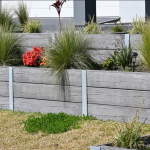
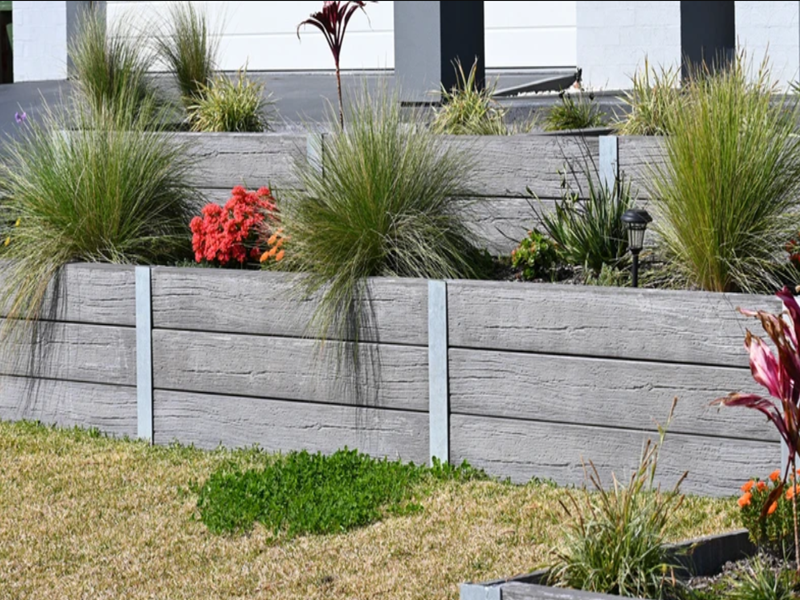
- Sleepers: reinforced concrete sleepers slide down between the posts, one on top of another, to form the face of the wall.
- Drainage: ag pipe, geofabric and free-draining gravel sit behind the wall so water can escape rather than build pressure.
Each sleeper is 200mm high, so a one-metre wall is five sleepers tall. Sleepers commonly come in 1.6m, 2.0m and 2.4m lengths, and the length you choose sets the spacing between posts.
Choosing the right post
Three post types cover most walls:
- H posts go mid-run. The H profile holds a sleeper on both sides, so one post supports the sleepers either side of it.
- C posts finish the end of a run. The sleeper sits in one side only, which gives the wall a clean edge.
- Corner posts handle a change of direction, for example where a wall turns around the corner of a pad.
Posts are also made in different series to suit the thickness of the sleeper, which is typically 75mm, 80mm or 100mm. The wall height and the load behind it decide how heavy the post needs to be, and that is a design question rather than a guess. Reo posts are a separate type again, so check which one your design calls for.
Because the posts are hot dip galvanised, they are suited to outdoor exposure where bare steel would rust. Galvanising is a coating, though, so it is worth avoiding unnecessary cutting or welding on site, and touching up any damage before the wall is backfilled.
A simple takeoff for a shed pad wall
- Measure the length of the wall along the line it will follow, and record any corners.
- Decide the finished height and divide by 200mm to find the number of sleeper rows.
- Pick a sleeper length and divide the wall length by it to find how many bays you need.
- Count the posts: one more than the number of bays in a straight run, with C posts at the ends, H posts in between and corner posts at any turns.
- Add drainage and finishing parts, such as ag pipe, geofabric, gravel, post caps and capping.
Buying the posts, sleepers and accessories in the one order means they can arrive together, rather than waiting on a second delivery for a missing part.
What to check before you order
- Height and engineering: walls over about a metre, and walls that carry a load such as a shed slab, a vehicle or a fence, generally need an engineer’s design and council approval in Queensland. If the wall sits close to the shed footing, get the design signed off before you buy anything.
- Site access: sleepers and posts are long, heavy loads delivered by truck. Check driveway width, gate clearance, overhead lines and where the load can be unloaded.
- Lead times: steel posts are usually available in one to five business days, while sleepers can take longer depending on the product and finish.
- Not a fence post: retaining wall posts are designed to hold a sleeper wall. They are not intended as stand-alone fence or gate posts, although fence brackets can be bolted to them if a fence will sit on top of the wall.
Where to find the parts in South East Queensland
For shed owners and builders in South East Queensland, Jobsite Direct is an online supplier of retaining wall materials, with more than 60 products across sleepers, posts and accessories. Its range of steel retaining wall posts includes H, C, corner and reo posts, all hot dip galvanised and listed with prices including GST (freight is extra).
Delivery is available across Brisbane, Ipswich, Logan, Redlands, Moreton Bay, the Gold Coast, the Sunshine Coast and Toowoomba, with freight priced online for most addresses. Orders outside those areas, or with special handling needs, are quoted before payment, usually within one to two hours during business hours. Free pick-up is also available. Jobsite Direct does not supply retaining wall blocks, and it does not deliver outside South East Queensland and selected nearby regions.
Contractors and builders can apply for a trade account to access trade pricing. The team is available from 7am to 6pm on 1300 211 390 for help with a materials list.
The short version
A level pad is only as good as the wall holding it. Work out the height first, confirm whether you need an engineer, choose posts and sleepers that match each other, and plan drainage from the start. Get those four things right and the wall will outlast the shed.