Custom Shade Sails in Melbourne: How to Choose Shade That Actually Lasts
Anyone who has spent a Melbourne summer on a bare patio, a school oval, or a baking car park knows the problem. One day the UV is punishing, and the next a cold front arrives with gusts that rattle anything that isn’t properly secured. Outdoor space only earns its keep when people can use it comfortably, and that takes more than a quick fix.
Effective outdoor shading solutions in Melbourne must be engineered to handle both the sun and the wind. This guide explains, in plain language, how to choose shade that does. Whether you’re planning custom-designed shade sails for a backyard or commercial shade sails for a whole site, the same basics apply.
Why does shade matter so much in Victoria?
Shade reduces both UV exposure and heat. Cancer Council Victoria says effective shade can cut a person’s UV exposure by 60% to 90% and lower surface temperatures by as much as 20°C. Because Australia has some of the highest skin cancer rates in the world, shade is a health measure as much as a comfort upgrade.
Shade works best as part of a bigger routine. Cancer Council Victoria still recommends hats, sunglasses, sunscreen, and covering clothing. Ultimately, when shade is expertly integrated into a space, staying safe becomes the easy choice.
What’s the difference between a shade sail and a shade structure?
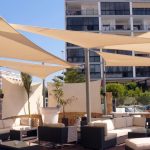
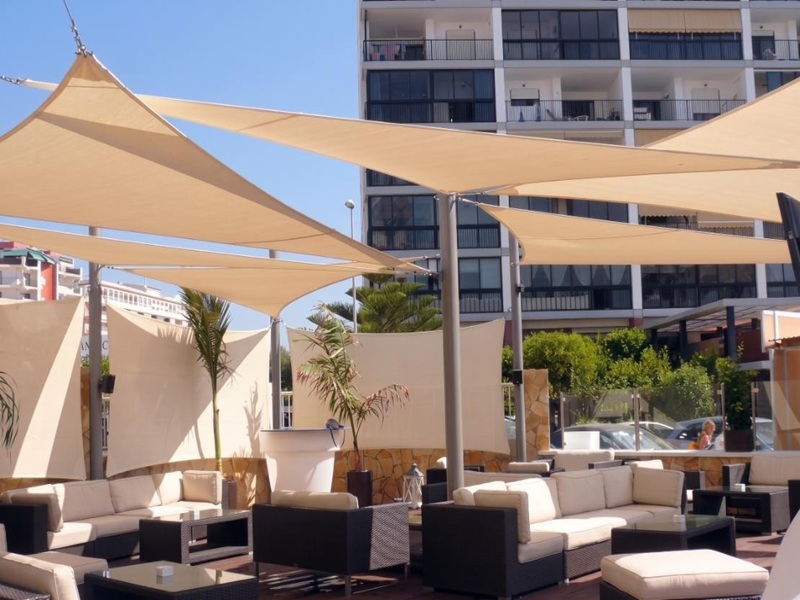
A shade sail is tensioned fabric stretched between posts or fixing points—typically in a triangle, square, or rectangle. “Shade structures” is the wider term. It includes sails, and it also covers hip, ridge, and cantilever designs built on engineered frames.
Sails are flexible and look great in overlapping layouts, which is why they suit backyards, pools, and playgrounds. Larger, more architectural shade structures in Melbourne tend to suit big spans such as car parks, sporting facilities, and school courtyards. A good installer will tell you which option suits your site rather than defaulting to one.
Which shade fabric should you choose?
It depends on what you need underneath. Breathable knitted HDPE fabric suits playgrounds, pools, and car parks because hot air can escape through it. Waterproof membranes suit patios and dining areas where you also want rain cover. For either, ask for the fabric’s UV rating.
UVE stands for Ultraviolet Effectiveness. It’s the rating used under the Australian standard AS 4174:2018 for knitted and woven shade fabrics, and it shows how well a fabric protects people from UV. You may also see UPF ratings, but those belong to clothing. ARPANSA, Australia’s radiation protection agency, recommends using UVE for shade structure fabrics instead.
One caveat: a fabric rating isn’t the whole story. Height, size, the sun angle, and where you stand all affect how much UV reaches you, because some UV arrives as scattered light. That’s why the design matters as much as the cloth.
If you’re considering waterproof shade sails in Melbourne, keep in mind that they don’t let air or water pass through. That puts more load on the posts and fixings, and the pitch needs to be engineered so water drains properly. They’re also treated differently regarding permits (more on that below).
Color matters too. Darker tones such as charcoal cut glare, while lighter tones such as sandstone or silver reflect more heat. Choose based on how the space will be used.
What makes a shade sail strong enough for Melbourne weather?
Three things: proper tension and shape, solid posts and footings sized for the site’s wind conditions, and corrosion-resistant fittings. Heavy-duty tensioned shade sails are far less likely to flap or sag, which protects both the fabric and the structure.
Hardware is where cheaper options often fall short. For long-term durability, look for 316 marine-grade stainless steel fittings and hot-dip-galvanized, powder-coated posts. This matters most near the coast. If you’re planning commercial shade sails in Geelong or along the Bellarine Peninsula, salt air will attack weaker metals over time.
Melbourne’s microclimates play a part. A courtyard between buildings, an exposed school oval, and a Geelong foreshore site all face different wind conditions, so the design should be based on your site, not a generic size chart.
Here’s a fair comparison of the two common routes:
- DIY or off-the-shelf kits
- Custom-designed and installed
Best suited to:
- Small, low-risk, or temporary areas
- Permanent, high-use or public areas
- Sizing
- Standard sizes
- Measured to your site
- Hardware
- Varies by kit, so check the material.
- Chosen for the conditions, such as 316 stainless near the coast
- Wind design
- Left to the owner
- Engineered for the site
- Permits
- Your responsibility to check
- Usually worked through with your installer
What should schools, childcare centers, and car parks look for?
Public and high-use sites should prioritize UVE-rated fabric, site-engineered structures, and a clear inspection plan. These structures protect children and customers every day, so there’s less room for guesswork than in a backyard.
For schools and early learning services, the Cancer Council encourages starting with a shade audit to see where shade already exists and where children actually spend their time. Experienced providers of school and childcare shade structures can use that information to plan coverage over play areas, walkways, and eating spaces.
Car park shade sails have a different goal: keeping vehicles and surfaces cooler and making the walk to the car more bearable. Because the spans are large, engineering and footings matter most. Hospitality venues often choose waterproof shade sails so outdoor tables stay usable in all weather.
Do shade sails need a building permit in Victoria?
Sometimes. Council guidance based on Victorian Building Authority practice notes says a permeable shade sail generally doesn’t need a permit if it is no more than 3.6 meters high, no more than 20 square meters in area, and meets siting rules. Many sails exceed those limits, and non-perforated (waterproof) sails are usually treated differently and need a permit.
Rules vary by property, so check with your local council or a building surveyor before you commit. It’s a short conversation that can save a lot of hassle.
How long do shade sails last, and how often should they be checked?
With quality fabric and fittings and regular checks, a shade sail structure can reasonably last 10 to 15 years. That’s the asset life one Victorian council uses for its shade sails, along with regular inspections as part of its playground safety audits.
A good rule is to check before summer and after any major storm. Here’s what to look for:
- Fabric: fading, fraying, thinning, or small tears, especially at corners and edges
- Tension: sagging or areas where water pools
- Fittings: rust, loose bolts, or worn cables
- Posts and footings: movement, cracks, or leaning
For larger sites, a professional shade sail audit can spot problems early, before a small repair turns into a full replacement. Regular shade sail maintenance is almost always cheaper than fixing storm damage.
Frequently asked questions
Are shade sails worth it in Melbourne?
For most outdoor areas, yes, provided they’re designed properly. They cut UV and heat, create usable space, and are a lighter-touch option than building a roof.
Can shade sails handle rain?
Breathable shade fabric lets water pass through, so it isn’t rainproof. Waterproof membranes shed water, but they need more careful engineering and usually a building permit.
How do I know if a shade sail gives enough UV protection?
Check the fabric’s UVE rating under AS 4174:2018 and ask your installer for the supporting details. Then consider the design, because height, size, and sun angle all affect real-world protection.
The bottom line
Long-lasting shade comes down to a few sensible choices: a fabric with a UVE rating you can check, hardware made for the conditions, a design based on your site, and regular inspections. Get those right, and shade structures in Melbourne can serve you well for many summers. If you’re unsure where to start, ask your installer to explain each choice in plain language. A good one will be happy to.