Accessible Toilets for Backyard Builds, Working Bees and Outdoor Gatherings
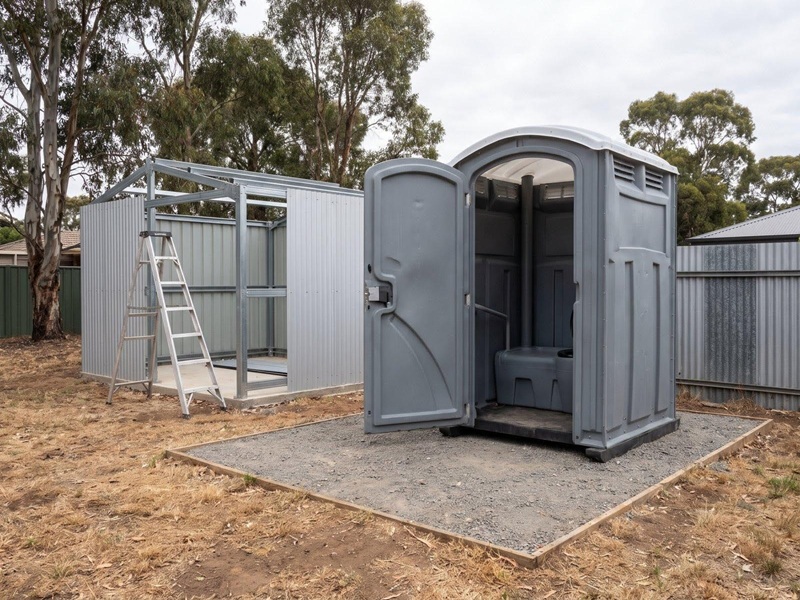
You’ve sorted the slab, booked the trades and ordered the steel. There’s a barbecue planned for the day the frame goes up, and half the street has promised to turn up. But there’s one question most owner-builders and weekend hosts skip: where does Nan, or your mate with a mobility issue, go to the loo for six hours?
A standard portable toilet won’t work for anyone who uses a wheelchair or walker. The door is too narrow, the cubicle too tight and the step too high. This guide covers who needs step-free facilities on a shed build or at an outdoor gathering, how many to plan for, and how to set the site up so the unit is genuinely usable. It also covers how to check that a hired unit is what the supplier says it is.
Who Actually Needs a Step-Free Toilet
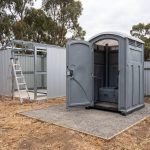
Most people picture a wheelchair user when they hear “accessible toilet”, but the group is much wider. It includes older relatives, people on crutches, a tradie recovering from a knee reconstruction and parents helping a child with a disability. What many suppliers call an ADA portable toilet is a unit with a wide door, grab rails and enough floor space to turn a wheelchair around, usually reached by a ramp rather than a step.
A quick terminology note. “ADA” is the US name, after the Americans with Disabilities Act, and it doesn’t apply here. In Australia the benchmark for accessible toilets is AS 1428.1, which sets out circulation space, door hardware, rails and fixtures. The 2021 edition calls for a clear area of roughly 1900 x 2300 mm. Ask any supplier which standard their unit was designed to, whatever label sits on the brochure.
This isn’t a niche issue. The Australian Bureau of Statistics found that 5.5 million Australians, or 21.4% of the population, had a disability in 2022, up from 17.7% in 2018. Among people aged 65 and over, 52.3% had a disability. If your project draws family, neighbours and visitors, the odds are good that someone will need step-free facilities.
Shed and Garage Builds
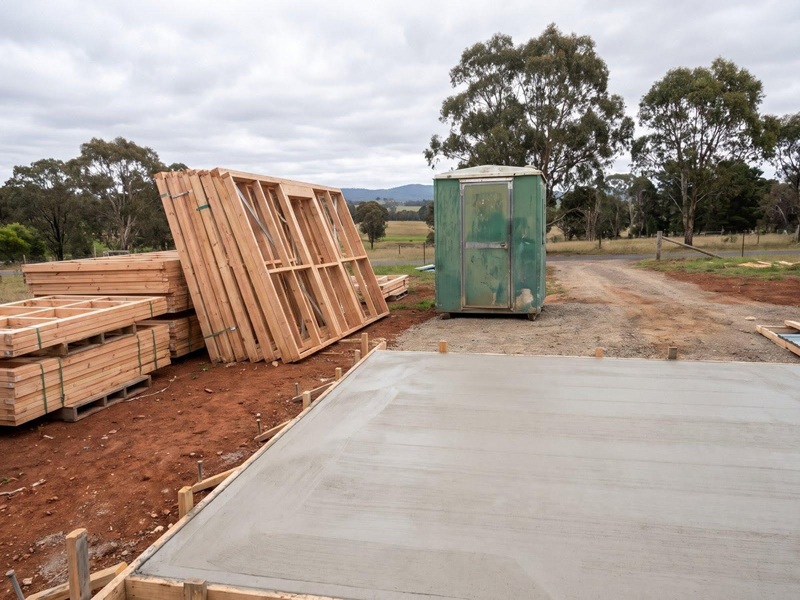
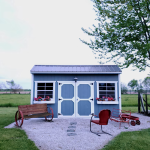
A shed build looks like a short job on paper. In practice, the slab, frame, cladding, electrical and roofing can run for weeks, with different trades turning up on different days. Someone needs to decide where they’ll use the toilet, and “the neighbour’s place” isn’t a plan.
SafeWork SA’s guidance on construction toilet facilities gives a useful benchmark. Model codes suggest one closet pan for every 20 men and one for every 15 women, and a single unisex toilet can be enough for ten people or fewer. Treat these as a starting point; your state’s rules and your builder’s contract may say otherwise. Owner-builders often forget that visitors count too: inspectors, delivery drivers, the engineer and family helpers all need somewhere to go.
If you’re planning the order of works, our guide to the trade sequence for building a shed is a good place to slot in the toilet. Book it before the first truck arrives, not after the plumber asks where he’s meant to go.
Working Bees, Patio Parties and Farm Gatherings
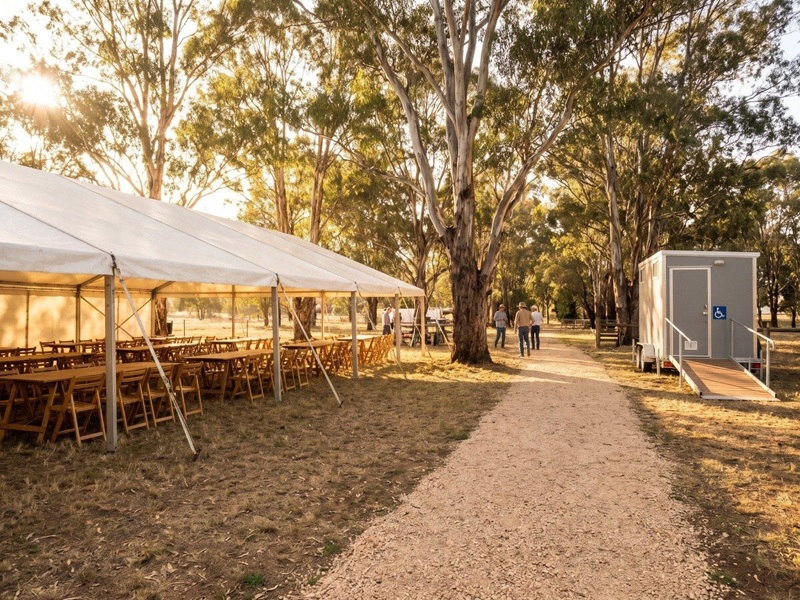
Once you pass a dozen or so people, you’re running an event, even if it’s only your mum’s seventieth under the new patio. The City of Sydney’s inclusive event guidelines are written for much bigger crowds, but the principles scale down well. Accessible portable toilets at outdoor events should have no foot-operated pumps, and the path to them needs to be step-free. A foot-operated pump is impossible for many wheelchair users to operate.
Add the accessible unit on top of your standard toilets, not instead of them. Plan on at least one accessible toilet at any event. That’s sensible even for a rural working bee or a club fundraiser on a paddock. Sloping, grassy or rutted ground makes things harder, so give this part of the plan extra time.
Camping, Caravans and Remote Blocks
Camping gets awkward fast for anyone with limited mobility. Many bush camps and free sites have a long-drop at the end of an uneven track, if they have anything at all. Caravan owners can lean on their onboard cassette, but that only works when the van itself is accessible and a dump point is nearby. Our caravan camping guide for first-timers covers the basics of cassette toilets and dump points.
Where a unit makes sense is group trips. Club rallies, family reunions and multi-day gatherings on private land can justify hiring an accessible unit for the weekend. You’ll need a site the servicing truck can reach, and you’ll want to confirm the delivery and collection times well ahead.
Getting the Site Right
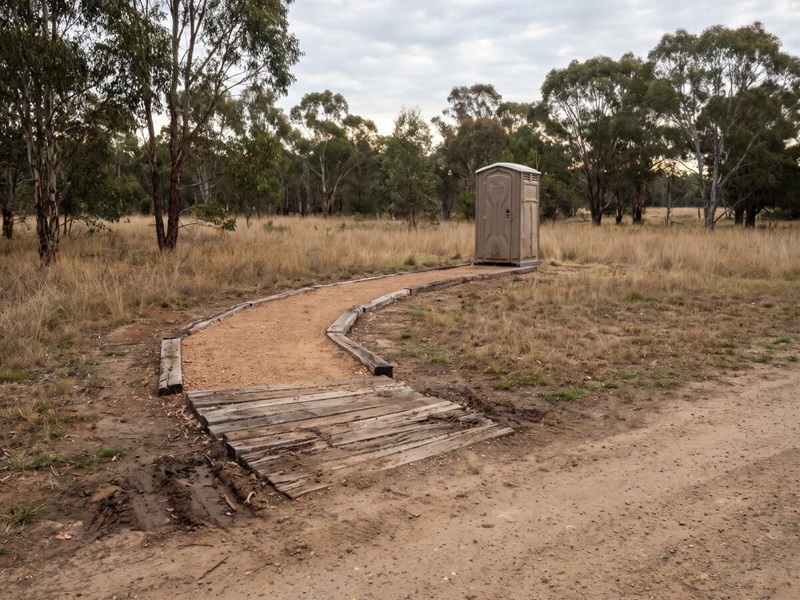
The best accessible unit is useless if a wheelchair can’t reach it. Walk the route from the car park or driveway to the door and look at it the way a wheelchair user would. Run through this checklist:
- Level pad: compacted gravel, or heavy-duty mats or boards laid over grass, so the wheels don’t sink.
- Clear path: wide enough for a wheelchair and free of cables, hoses, pallets and timber offcuts.
- Ramp and threshold: the ramp should be firm and not too steep, with no lip at the door.
- Lighting: a torch won’t do for an evening or an early winter finish.
- Placement: close enough to be convenient, but out of the way of the build, vehicles and the barbecue.
- Servicing access: the truck needs a clear route in and out, and you need to know when it’s coming.
Temporary hire is also a handy bridge while you wait on permanent plumbing. If you’re thinking about adding a bathroom to your shed, our article on adding services to a backyard shed explains what’s involved and why it takes time.
Checking a Hired Unit Is Genuinely Accessible
Not every unit sold as “accessible” is. Hired units can fall short in small ways that matter, like missing backrests, too little circulation space or the wrong door hardware. Organisers can face real exposure under disability discrimination law if the facility doesn’t work, though that’s a question for proper legal advice.
Before you pay a deposit, ask the supplier:
- Was the unit designed to AS 1428.1, or does it just have rails?
- What’s the internal floor space and the door width?
- Is there a ramp, and is the floor non-slip?
- Does it flush without a foot pump?
- What’s included in delivery, servicing and collection?
The Australian Disability Network’s Design for Dignity guide to accessible toilets is a handy reference for what good design looks like, and a fast way to spot a unit that falls short.
Plan for It From Day One
Treat the accessible toilet like the slab or the power supply: something you sort in the planning stage, not a last-minute phone call the night before. It costs little compared with the rest of the project, and it means nobody has to leave early or stay home. Add it to the checklist, check the ground and the path, and ask the hard questions before you book. Your guests will notice if you get it right.