LED Shed Lighting: What to Fit, What It Costs to Run, and When a Rebate Pays for It
Most sheds are lit by whatever was cheapest on the day they were built. A couple of fluorescent battens in a home workshop, or a row of big 400 watt high bays in a farm or factory shed. Both still work, which is why they are still there. But both cost more to run than they need to, and in some cases the upgrade to LED is paid for almost entirely by a state energy scheme. Here is how to work out what suits your shed.
Start with the height of the roof
The right fitting depends mostly on how high it hangs.
In a standard garage or workshop with the lights under about 4 metres, LED battens are the simple choice. They throw a wide, even light, they clip up where the old fluorescent fittings were, and a good one uses about 25 to 40 watts.
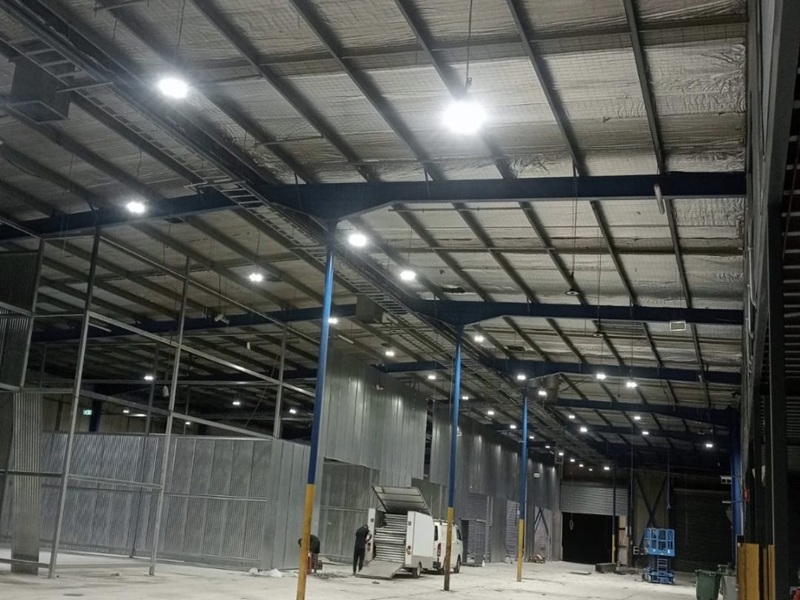
In a tall shed, where the lights sit 5 metres or more above the floor, battens run out of reach. That is the job of a high bay, the round dome light you see in warehouses and machinery sheds. Old high bays are usually 400 watt metal halide or mercury vapour lamps. An LED high bay does the same job on a fraction of the power and comes on instantly, with no warm up.
Outside, the equivalent of the old 400 watt floodlight over the roller door or the yard is an LED flood, which uses far less power for the same spread.
How much light does a shed need?
For general workshop tasks, aim for roughly 300 to 400 lux at bench height. As a rule of thumb, multiply the floor area in square metres by 350, then divide by 0.6 to allow for losses. That gives you the lumens to buy.
A 6 by 6 metre shed is 36 square metres, so it needs about 21,000 lumens. Six LED battens at around 4,000 lumens each will do it comfortably. If you do fine work like welding prep or small engine repairs, add a batten or a task light over the bench.
Two other things are worth checking on the box. Choose a colour temperature of 4000K to 5000K, which is a clean white that shows true colours. And in a dusty or damp shed, look for fittings rated IP65 so dust and moisture stay out.
What it costs to run
This is where LED earns its keep. At 30 cents per kilowatt hour:
- A 40 watt LED batten used four hours a day costs about $17 a year.
- An old 400 watt high bay draws about 450 watts once you count its control gear. Run ten hours a day, five days a week, it costs about $350 a year.
- The LED that replaces it draws about 70 watts and costs about $55. That is close to $300 a year saved on every light.
In a shed with ten high bays, that adds up to almost $3,000 a year. Floodlights that run from dusk to dawn save even more per fitting, because they are on for so many hours.
If the shed is part of a business in South Australia
Here is the part many shed owners do not know. In South Australia, the Retailer Energy Productivity Scheme, known as REPS, pays for most of the cost of replacing old commercial lighting. For 400 watt high bays and floodlights the incentive is large enough that eligible businesses pay a single $33 co-payment for the whole site, however many lights there are. The details are set out in this guide to the LED high bay upgrade for South Australian businesses.
It applies to business premises, which can include farm sheds, packing sheds, workshops and warehouses. Fluorescent battens and ceiling panels are covered too, at a small cost per fitting. You can see the indicative prices for LED lighting upgrades in Adelaide.
A shed or garage at home is not covered. And other states have their own schemes and rules, some of which no longer include high bays, so check what applies where you are.
Three things to get right before anyone touches the wiring
- Do not replace the old lights first. Under the South Australian scheme the existing lights must be in place and working when the installer arrives. If you have already swapped them, the incentive is gone.
- Use the right person. Fixed wiring in Australia must be done by a licensed electrician, and that includes hard wired shed lights. For a rebated upgrade, a regular electrician is not enough. The work has to be done by an installer accredited under the scheme, because they are the ones who can apply the incentive.
- Get the cost in writing. A proper quote shows the full price, the scheme discount and what you pay. If someone cannot show you that, keep looking.
The short version
Low roof, use LED battens. High roof, use LED high bays. Work out your lumens from the floor area, pick a clean white, and check the IP rating if the shed is dusty or damp. If the shed belongs to a business in South Australia, find out what the state scheme covers before you spend anything, because the upgrade may cost you $33.