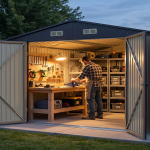
From Workshop to Retreat: How to Make a Shed Feel More Like a Finished Room

A shed can be perfectly weatherproof and still feel like a place where the mower lives. Bare concrete, exposed framing, harsh overhead light and rows of open shelving all reinforce the idea that the building is for work or storage, even when you want to use it as an office, hobby room or quiet backyard retreat.
Making a shed feel more like a finished room doesn’t require hiding every trace of its practical origins. Focus first on the things you notice every time you step inside: temperature, light, flooring, sound, storage and layout. Decorative choices work much harder once the shell of the building is comfortable.
Decide What Kind of Room You Are Making
Before buying furniture or wall finishes, decide how the shed will actually be used. A woodworking space needs different flooring and ventilation from a reading room. A home office needs reliable power, glare control, and a comfortable working temperature. A mixed-use shed may need a clean zone at one end and a tougher workshop zone at the other.
There is also a compliance point to consider. The National Construction Code defines a Class 10a building as “a non-habitable building including a private garage, carport, shed, or the like” (Australian Building Codes Board [ABCB], 2022). If you plan to use the structure for sleeping, accommodation or another purpose that changes its classification, check requirements with your local council or a suitably qualified building professional before you begin.
Get Insulation and Moisture Control Right
A finished-looking room won’t feel finished if it is stifling in January and freezing in July. Insulation should be part of the plan early, particularly in a metal shed.
The Australian Government’s YourHome guidance on insulation explains that insulation slows heat flow through a building, helping to manage indoor temperatures (Australian Government, n.d.-b).
Condensation forms when humid air meets a cooler surface and can contribute to damp, mould and decay (Australian Government, n.d.-a). That is especially relevant in metal buildings. Fix leaks first, seal unwanted gaps, and then plan insulation, membranes, and ventilation as a system. ShedBlog’s guide on how to insulate a metal shed is a useful shed-specific starting point.
Make the Floor Feel Intentional
The floor has an outsized effect on how the room feels. A bare slab suits dirty jobs, but it can make an office or hobby room seem unfinished and acoustically harsh.
You don’t always need to cover the whole surface. A sealed or coated concrete floor can remain practical, while a rug defines the cleaner part of the room. In a long shed, a runner between the entry and a desk, reading chair, or storage wall can soften the main traffic path without interfering with work areas. Looking through a runner rugs sale can help you compare long-format proportions before measuring the floor and deciding what will fit.
Keep rugs away from welding, grinding, wet work, or areas where oils and chemicals are used. For permanent flooring, ShedBlog’s guide to choosing the right floor for your shed space covers the available options in more detail.
Use Lighting in Layers
A single bright batten light can make a shed functional, but it rarely makes it comfortable.
Use three layers where possible: general lighting for moving around safely, task lighting over a desk or bench, and softer local lighting for reading or relaxing. YourHome notes that good lighting design combines daylight with well-planned electric lighting and that task lighting can be more efficient than trying to make an entire room equally bright (Australian Government, n.d.-c).
Natural light helps too, but more glass isn’t automatically better. Window placement, orientation, and shading affect glare and heat gain. If afternoon sun makes the shed uncomfortable, blinds, external shading, or a better-positioned work surface may solve the problem more effectively than adding more cooling.
Tame Echo and Hard Surfaces
Sheds often contain sound-reflective materials such as steel cladding, plasterboard, concrete, and glass. Even after machinery stops, the room can sound hollow.
Curtains, upholstered seating, rugs, and fabric-covered acoustic panels can soften that character. Lined walls and a finished ceiling can help too. If part of the shed remains a workshop, remember that acoustic comfort and hearing safety are different issues. Soft finishes can reduce reverberation, but they don’t replace hearing protection around loud tools.
Hide Some of the Workshop
A shed starts to feel like a room when every object isn’t on display.
Open pegboards are useful above a workbench, while closed cupboards can hide paint tins, chargers, hardware, and half-finished projects. Use the perimeter for tall storage and keep the centre as open as possible. Wall-mounted cabinets and shelves are especially useful in smaller sheds.
If the building serves two purposes, storage can also create a visual boundary. A low cabinet, open shelving unit, or change in floor finish can separate the practical zone from the quieter one without adding another wall.
Choose Finishes for Real Shed Life
Residential finishes can work in a shed, but they still need to suit the building. Choose surfaces that tolerate dust, knocks, and temperature changes. Washable wall paint, durable trims, and easy-clean flooring are usually more sensible than delicate materials.
If you line the walls, plan access to services before closing everything up. It is much easier to run cables, add backing for shelves, or deal with insulation details while the framing is still accessible.
There is no need to erase the shed’s character. Exposed steel, timber framing, or a workshop bench can sit comfortably beside cleaner finishes when the materials look deliberate rather than unfinished.
Plan Power, Data, and Climate Control Early
Powerpoints, lighting, internet, and heating or cooling should be considered before furniture goes in. Extension leads running across a newly finished floor quickly undo the sense of order you have created.
Use a licensed electrician for fixed electrical work and check local requirements for new circuits, outlets, or lighting. If the shed will be used as an office, test Wi-Fi strength before fixing the desk position.
For heating and cooling, size the solution to the room and climate. Good insulation, shading, and ventilation can reduce how hard mechanical systems need to work.
Conclusion
A shed doesn’t need to imitate a living room to become somewhere you enjoy spending time. The biggest change comes from treating it as an occupied space rather than a storage shell.
Get the building envelope right first. Then improve the floor, lighting, and acoustics, contain visual clutter; and choose finishes that can cope with real shed use. A few well-judged changes will usually do more than a room full of decorative accessories.
Most importantly, design around the way you will use the shed. A practical workshop can still feel warm and considered, while a backyard office or hobby room can retain enough toughness for muddy shoes, tools, and weekend projects. That balance is what turns a basic outbuilding into a space that feels genuinely finished.