The Business Traveller’s Guide to Renting a Car in Casablanca
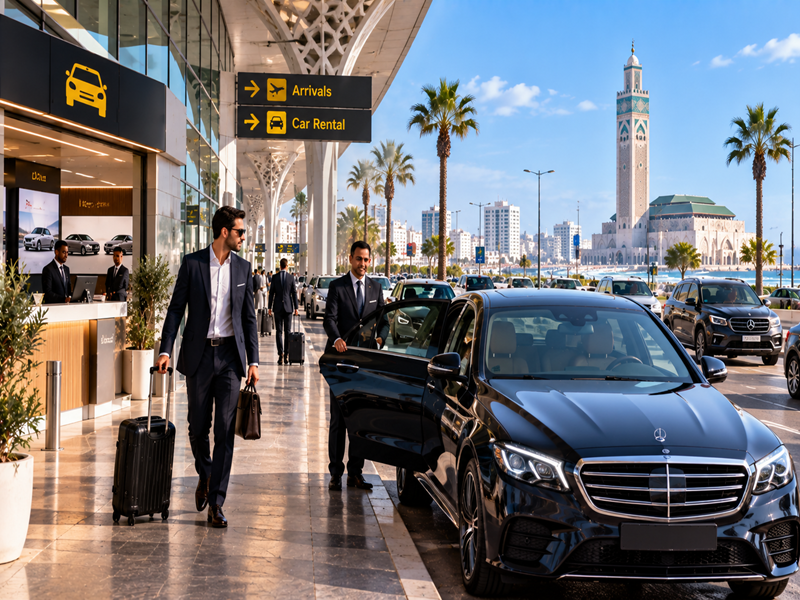
Casablanca is where Morocco does its deals. The country’s corporate headquarters cluster along its boulevards, the Casablanca Finance City towers host half the continent’s regional offices, and Mohammed V airport funnels a daily tide of suited arrivals who have precisely zero interest in this trip. For that traveller, the city presents a specific problem the leisure guides never address: a working week here means crossing a genuinely vast metropolis several times a day, between the airport thirty kilometres south, the financial district, the industrial zones of Ain Sebaa, and dinners back on the Corniche, and the taxi arithmetic of that schedule collapses by Tuesday. The working answer, as every Casablanca regular eventually concludes, is your own keys.
The market is built for the conclusion. The listings of cars for rent in Casablanca run deeper and wider than anywhere in the kingdom, economy models from around 200 to 350 dirhams per day for the cost-conscious consultant, solid sedans and crossovers from roughly 400, and a genuine executive tier, German sedans and premium SUVs, that exists here at fleet depth because this is the city whose clients expect them. Pickup covers Mohammed V airport, the Casa Voyageurs station for the train arrivals from Rabat and Tangier, and direct delivery to hotels and offices, and the booking runs on the comparison-first model that suits a diary-driven trip: verified suppliers on one screen with real photos and transparent pricing, the assisted team confirming the exact car and gearbox against your flight times, a small advance of around ten percent securing it, and the balance settled with the supplier at handover. The gearbox line matters doubly for this audience, since manual is Morocco’s default, the automatic is the business traveller’s near-universal preference, and the automatic fleet is exactly the one that the corporate season drains first.
Here is the rest of the working-week craft, learned once and reused every trip.
Timing the City, Not Fighting It
Casablanca traffic is the most assertive in Morocco, and the professionals beat it with the calendar rather than the horn. The crush runs roughly eight to ten in the morning and five to eight in the evening, so the schedule that works slots the cross-town meetings into the generous mid-day window, books the airport runs outside the peaks, and treats the first drive in from Mohammed V, thirty smooth autoroute minutes when timed right, as the gentle introduction it genuinely is. The driving grammar, once learned, is consistent: roundabouts negotiated on confident eye contact, lanes treated as suggestions at rush hour, petit taxis and scooters threading everywhere, and calm predictability as the only strategy that works. The first hour of adjustment is the whole tuition.
Parking is the second craft, and the city runs it on two systems worth carrying coins for: marked blue zones with small hourly fees along the business boulevards, and the vested guardians who watch cars at the informal spots for a few dirhams, an institution to embrace rather than resist. Hotels and the major towers solve it with valets and basements, fuel stations are frequent and full service for the week’s top-ups, and the radar culture rewards the one habit that costs nothing: posted speeds, always, with documents within reach for the routine checkpoint courtesy. Two closing rules keep the week smooth: skip unfamiliar districts after dark when the diary allows, and leave the old medina to pedestrians, parking at its edges on the one afternoon the trip turns tourist.
The paperwork and protections compress into a paragraph the frequent flyer memorises. A home licence held at least a year, an International Driving Permit recommended, passport and a deposit card, minimum ages generally from 21; the insurance excess confirmed by name at booking with the reduction option priced, mileage terms matched against the week’s genuine kilometres, and the two-minute filmed walkaround at handover, panels, wheels, spare, and triangle, kept until return. On the executive tier the same habits simply carry higher stakes, which is exactly why the five minutes stay non-negotiable.
The Hours Between Meetings
The business week here hides a decent holiday in its margins, and the car collects it. The Hassan II Mosque, one of the great buildings of the modern world, absorbs a free morning entirely and sits an easy drive from every business district; the Corniche at Ain Diab turns a client dinner into a seafront one; and the Habous quarter compresses the full Moroccan souk experience, arcades, olives, pastries, leather, into a genteel ninety minutes that fits between an afternoon call and an evening flight. The weekend extension writes itself in two directions: Rabat, the serene capital, is barely an hour north by autoroute for the Kasbah and the stork-crowned Chellah, and Marrakech waits two and a half hours south on the A7 for the traveller who tacks Saturday onto the trip, with one-way drops arrangeable at booking when the itinerary refuses to loop.
For the executive whose Morocco schedule runs beyond the Atlantic corridor, it is worth knowing the premium fleet model now covers the whole map, including its least expected corner: the eastern capital’s luxury tier at www.oneclickdrive.ma/oujda/luxury-car-rental lists Range Rovers, Mercedes, and statement SUVs for the Oriental region’s particular calendar, the diaspora summer, the wedding season convoys, the Saidia resort weekends, booked through the identical assisted process with the handover timed to flights into Angadas airport. Regional managers covering the east, and anyone whose family occasions call them home to Oujda in style, no longer trade down at the far end of the country, which is a quiet measure of how far Morocco’s rental market has matured.
The closing arithmetic is the one every Casablanca regularly runs on the flight home. A week of taxis across this city costs more than a week of the right car, delivers none of the schedule control, and turns every tight connection into a negotiation; the rental inverts all three, adds the mosque morning and the Rabat Saturday at zero marginal cost, and starts from the price of a client lunch per day. Morocco’s business capital rewards the traveller who moves through it on their own clock, and the clock, here, comes with keys.