Sizing a Dehumidifier for Water Damage: Read The Job Before The Litre Sticker
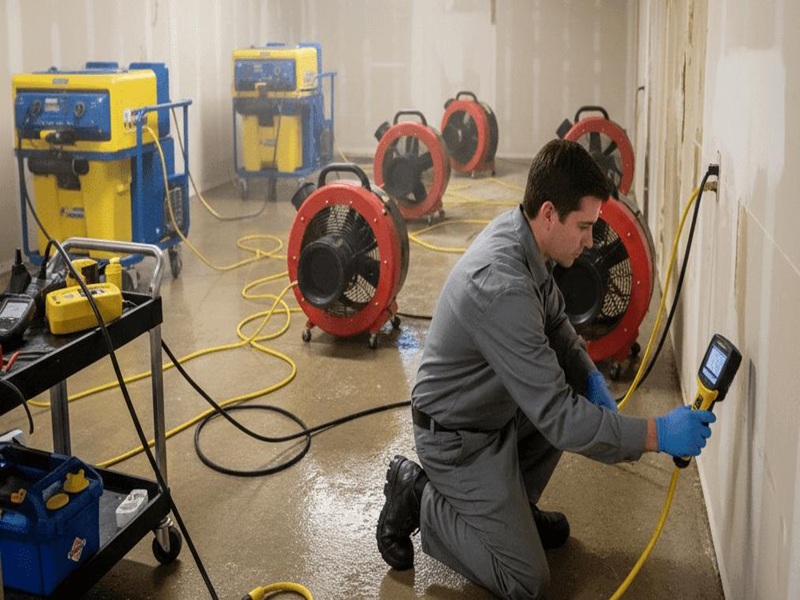
Every water-damage job comes down to one question: “How big a dehumidifier do we need?” On a carpet callout that turned into a flood job, a builder’s leak repair or an insurance make-safe, the usual answer is the biggest number on a carton. That is how you get a machine that trips the board, stalls on day three, or sits in a room it was never going to dry.
Sizing is not one figure. It is a few questions about the space, the conditions, the power and the drain.
This is for carpet cleaners, builders and insurance-repair crews who handle water damage. It is not a drying protocol and does not replace the moisture map or the insurer’s scope. It is the thinking to do before you buy, hire or load a unit.
Start with the chamber, not the carton
A dehumidifier takes moisture out of the air. It does not dry carpet, plaster or timber on its own. Air movers speed up evaporation from wet materials; the dehumidifier collects that moisture so the room does not just fill with wetter air.
So the first sizing question is: what space is the dehumidifier working on? One closed bedroom, an open-plan living area with a hallway, or a whole ground floor with doors you cannot close? Can you contain it?
Venting wet air out an open front door is ventilation, not dehumidification. Close the area when the method calls for it, then size for that area.
Write down the affected area, the wet materials (carpet and underlay, plasterboard, timber, cabinetry) and how wet they read. That list decides the job.
Know which class of machine you are sizing
A domestic appliance-aisle dehumidifier is built for comfort humidity. Restoration drying means pulling moisture out of a structure for days while the air gets steadily drier.
That is why most restoration crews start with an LGR (low grain refrigerant) unit. “Grain” is a measure of how much water is still in the air. As a room dries, that number falls, and a conventional refrigerant unit starts to struggle. An LGR dehumidifier is built to keep extracting at those lower grains, which is the stretch of the job that decides whether you pull the gear out on day four or day eight.
Read the test conditions behind the litres
Litres per day is the number everyone shops by, and the easiest one to misread. The question is always: litres per day at what temperature and humidity?
Restoration Warehouse’s trade buying guide to choosing a dehumidifier for restoration drying sets this out plainly. The usual AHAM test point is 26.7°C and 60% relative humidity. “Maximum” or saturation figures are commonly quoted at about 32°C and 90% RH. They are different claims and should be compared separately.
The guide’s own examples show why. The Dri-Eaz BD2500 lists 36 L/day at the AHAM point and 63 L/day at 32.2°C and 90% RH. Same machine, two very different numbers. The DryTrak Mini Upright lists 50 L/day, but at 30°C and 80% RH, which is a warmer, wetter test point than the standard AHAM one.
Line up published figures at the same test point. A litre number with no conditions is an unknown.
Count the circuit before you count the machines
On a real site, the power board often limits sizing more than the moisture does. The dehumidifier shares circuits with air movers, maybe an air scrubber, and whatever the occupants still run.
Add the dehumidifier to your power plan first, then fit the air movers around it. The buying guide lists the DryTrak Mini Upright at 3.1 A on 240 V and the Dri-Eaz BD2500 at 3.4 A on 230 V. Those are moderate loads, but they still count. Two machines that look fine on paper can trip an old board once the fans are on.
Always confirm the model and the nameplate voltage for an Australian site before you buy. A similar-looking listing built for a different electrical supply is not the same machine.
Plan the drain and the path in
A dehumidifier that needs its tank emptied every hour is not restoration kit. Size for a pump-out or continuous drain, and check that the hose will reach a safe drain point without running across a finished hallway. The guide lists an integrated condensate pump on the DryTrak Mini, and automatic pump-out with a 12.2 m drain hose on the BD2500.
Then check access. A compact upright fits apartment hallways, tight stairwells and small bathrooms where a bigger unit will not. Sometimes the answer is two smaller machines in two contained areas, not one large one in a corridor.
Check the operating range too. The guide lists 5°C to 38°C for the Mini and 1°C to 32°C for the BD2500. An unheated slab in winter and a closed-up room in a Queensland summer are not the same conditions, so match the machine’s listed range to the room you are drying.
Match the shortlist to the job
The restoration dehumidifiers from Restoration Warehouse are a short, deliberate list for structural drying and water-damage work: the DryTrak Mini Upright LGR Dehumidifier 50L, the XPOWER 85L2 LGR commercial low grain refrigerant dehumidifier, and the Dri-Eaz LGR Dehumidifier BD2500 230 Volt. The category tells buyers to compare extraction capacity, operating range, airflow, power, drainage and monitoring against the project conditions. Treat that as your sizing checklist.
If the job is bigger than the fleet you own, or it is a one-off, the same category notes that dehumidifiers can be hired in Brisbane from the equipment-hire list, including a large commercial dehumidifier. That often suits a builder or insurance repairer who only sees a big loss now and then.
Keep a simple record of each job
Whatever you choose, write it down. Record the machines placed in each chamber, the circuit each one is on, and the readings you take each day. That record shows whether the plan is working, helps explain the job to the owner or insurer, and makes the next similar job quicker to plan.
Size, then prove it with readings
Sizing is a starting estimate, not a promise about drying time. Extract standing water first. Contain the area. Set the dehumidifier and air movers for the space you defined. Then take readings.
The machine’s display shows it is running, not that the structure is drying. Your moisture meter and daily log show that. If readings stall, rethink containment, airflow, a second unit or a different class of machine.
A dehumidifier that suits the chamber, the conditions, the circuit and the drain will do more than the biggest litre figure on the carton, and you are less likely to be explaining an extra week of drying to the assessor.