Six Questions to Ask Before Buying a Large Span Fabric Structure
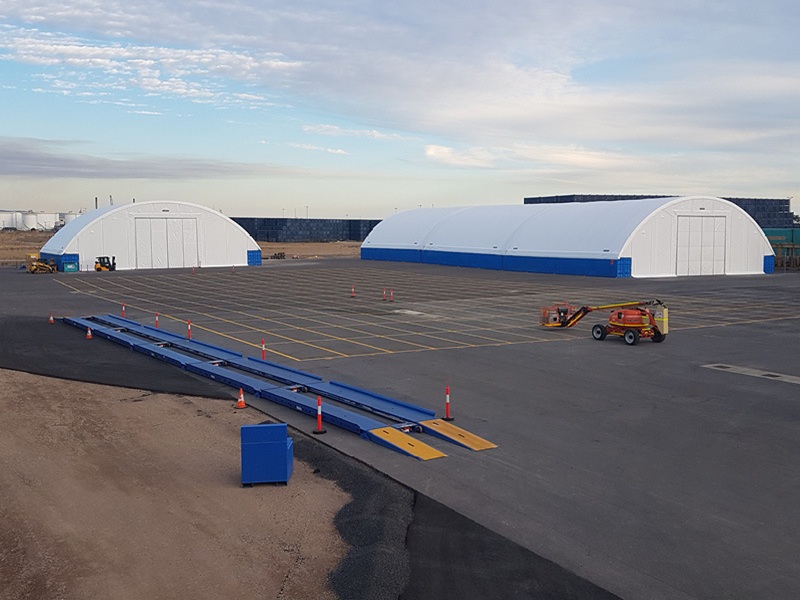
Before You Buy a Large Span Fabric Structure, Ask These Six Questions
Fabric structures have crossed a threshold in Australian industry. What began as temporary site cover has become mainstream infrastructure: bulk commodity storage, aircraft hangars, waste transfer stations, workshops spanning wider than most sheds, all under engineered fabric membranes on steel frames. The appeal is obvious. Faster to erect than conventional buildings, naturally lit, cooler in summer, and relocatable when operations change.
But the category’s growth has attracted a wide quality range, and at large spans the difference between a properly engineered structure and a cheap one is not cosmetic. A 10 metre shelter that fails is an expensive nuisance. A 20 or 30 metre span over plant, product or people is a structure whose failure mode you need to take seriously before you buy, not after.
If you are evaluating a large dome shelter for an industrial site, these six questions will sort the market quickly.
1. Is it engineered for your wind region, and can they prove it?
This is the question that matters most and gets asked least. Australia’s wind loading standards divide the country into regions, and the load a structure must survive in coastal Queensland is a different engineering problem to a sheltered Melbourne yard. A large fabric span presents an enormous sail area, which is precisely why the good manufacturers engineer to current Australian standards and can produce site-specific engineering documentation, with configurations rated well beyond 300 km/h available for cyclonic regions.
The proof is the point. If a supplier cannot hand over engineering certification your project engineer or certifier will accept, the price does not matter. Tier-one mining and construction clients will not let the structure on site without it, and their standards are a useful proxy even if your site is less demanding.
2. What does the warranty actually cover?
Fabric structure warranties are marketed as a single number and written as three separate promises: the steel frame, the fabric membrane, and the workmanship that joins them. Plenty of warranties cover one of the three and are silent on the rest, which becomes relevant the day a seam lets go or a weld cracks and each party points at the other.
The benchmark at the reputable end of the Australian market is ten years across all three, frame, fabric and workmanship, from a single manufacturer who made all of it. Anything narrower is a pricing signal, not necessarily a dealbreaker, but it should cost proportionally less and you should know what you are carrying.
3. Who manufactured it, and where?
Imported structures can be perfectly good, but large spans raise the stakes on three things that local manufacturing solves cleanly: engineering designed against Australian standards from the outset rather than adapted afterward, replacement fabric panels and components available from a local plant rather than a shipping lead time, and a manufacturer who can physically attend site for repairs, audits or modifications over a structure’s multi-decade life. ISO certification is worth checking too, less for the certificate itself than for what it says about whether the manufacturer’s quality systems will survive your client’s compliance review.
Longevity in the industry is its own signal. Companies that have been engineering fabric structures locally for a quarter of a century have a fleet of structures in the field proving their claims, and case studies you can go and look at.
4. Container mounted, ground mounted or clear span?
Large fabric structures come in three broad formats, and the right one depends on what is underneath.
Container mounted structures span between shipping containers, using them as walls and gaining lockable storage in the bargain. They suit sites that already run containers and need the structure to move eventually. Ground and post mounted structures fix to footings or walls, suiting longer-term installations. And true clear-span designs remove containers from the equation entirely, opening up the widest unobstructed floor areas for bulk storage, hangars and workshops where machinery needs to move freely.
A supplier with all three formats in their range will recommend based on your operation. A supplier with one format will recommend that format.
5. What happens when the operation changes?
One of the genuine advantages of a large dome shelter over a conventional building is that it is engineered to be permanent but designed to be relocatable. Structures can be dismantled, transported and reassembled as sites evolve, which turns the purchase from sunk site cost into a transferable asset. But relocatability varies with format and foundation choice, so if a future move is plausible, say so at design stage. Ballasted hold-downs, modular frames and container mounting all preserve the option; cast-in footings spend it.
Also ask about extendability. Operations grow, and the better modular systems can be lengthened with additional bays or joined rather than replaced.
6. What is included, and what is priced separately?
Large structure quotes vary widely in scope, and the headline price rarely tells you whether endwalls, doors, guttering and downpipes, lighting, delivery and installation are inside it. Installation is the one to nail down hardest: some structures arrive as kits an experienced site crew can erect, others warrant professional installation, and at large spans professional installation is usually worth specifying regardless, since warranty claims and workmanship arguments disappear when the manufacturer’s own team put it up.
Ask for the inclusions in writing and compare quotes on scope before comparing them on price. The cheapest quote for a large span is frequently the least complete one.
The pattern behind all six questions
Every question above is really the same question: is this a manufacturer or a reseller, and will they still be standing behind this structure in year fifteen? Large fabric structures are genuinely excellent infrastructure when they are engineered, certified, warranted and supported properly, and a liability at scale when they are not. The suppliers who welcome these questions are the ones to shortlist. The ones who deflect to the price have answered them anyway.
Allshelter has manufactured engineered fabric structures at its NSW plant since 1999, pioneering Australia’s container shelters in 2003 and supplying mining, construction, industrial, waste and aviation clients nationwide and internationally. Every shelter is engineered to Australian standards, ISO certified, and backed by a 10-year warranty across frame, fabric and workmanship. Browse the full range at allshelter.com.au.