Powering the Shed Properly: The Wiring Guide Every Workshop Owner Needs
There is a natural progression to shed ownership. First it is storage. Then a bench appears. Then a drop saw, a compressor, a bar fridge, half a dozen battery chargers, and suddenly the single power point fed by an extension lead from the laundry is running a small industrial operation. That lead, draped across the lawn, cooked by UV and pinched under the roller door, is the most common and most dangerous shortcut in Australian backyard workshops, and almost every shed has one at some point in its life.
Why Sheds Fail Electrically
Sheds are hostile environments for electrics in ways houses are not. Steel structures conduct. Dust from timber and grinding is both conductive and flammable. Humidity and condensation attack connections through every seasonal cycle. Vermin treat unprotected cable runs as both highway and snack. And workshop loads are brutal: the startup surge of a compressor or welder dwarfs anything a domestic circuit normally sees, and it arrives dozens of times a day.
The failure pattern is predictable. Overloaded double adaptors, nuisance tripping, power tools browning out under load, and in the worst cases fires that start in the one building on the property packed with fuel, solvents, timber offcuts and nobody watching. It is also the failure that announces itself at terrible hours: the freezer circuit that dies on Friday night with a side of beef inside, or the fault that takes the house circuits down with it. It is worth knowing that a 24 hour electrician Gold Coast can actually raise at midnight for exactly these moments, because a fault that keeps re-tripping or anything accompanied by a burning smell is an emergency call, not a Monday job. Better still, set the shed up so that call never needs to happen.
The Right Way to Feed a Shed
A dedicated sub-main and sub-board. The gold standard is a properly sized underground consumer main running from the house switchboard to a small sub-board inside the shed. It isolates the shed’s electrical chaos from the house, gives you local isolation for the whole building with one switch, and leaves room to grow when the next machine arrives. Overhead feeds are possible but underground runs, in the right conduit at the right depth, age far more gracefully.
Circuits by purpose, not convenience. Lighting on its own circuit, so a tool fault never leaves you standing in the dark holding a spinning blade. General power on another. Dedicated circuits for the heavy hitters: welder, compressor, dust extraction. A useful rule of thumb is that any machine with a plug bigger than your hand deserves its own breaker.
Safety switches on everything. RCD protection on every final sub-circuit is non-negotiable in a workshop, where damaged leads, metal filings and damp concrete floors are simply a way of life.
Plan for 15 amp and three-phase early. Even if you do not own a 15 amp tool yet, running the capacity while the trench is open costs very little. Retrofitting it later costs a weekend of digging and roughly twice the money. Serious machinery ambitions, such as a decent lathe or a large compressor, are the point to discuss three-phase.
Think about the ceiling. Overhead retractable reels for power and air keep leads off the floor entirely, which is the single best usability and safety upgrade any workshop can make. Position them over the bench and the middle of the main work zone.
The Legal Bit, Which Is Also the Smart Bit
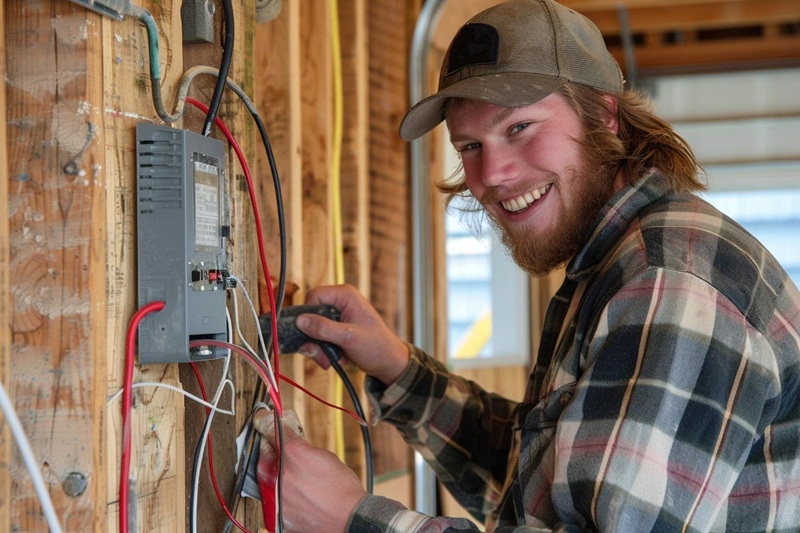
In Queensland, everything above is licensed-electrician work: running the sub-main, fitting the board, adding circuits, even replacing a damaged power point. DIY mains wiring is illegal, uninsurable, and around machinery it is a genuinely bad bet with your own hands as the stake.
What you can legally do, and should, is the planning. Sketch the shed layout. List every machine with its rated current off the nameplate. Mark where the bench, the welder bay, the charging corner and the future machines will live. Hand that document to your electrician. A clear brief turns a vague “power to the shed” quote into a precise and usually cheaper one, because nobody is padding for unknowns.
Charging Corner: The New Fire Risk
One modern addition belongs in every shed plan: a dedicated charging station. Lithium batteries for tools, mowers, e-bikes and scooters now represent one of the fastest-growing fire causes in Australian sheds and garages. Give the chargers their own RCD-protected circuit, mount them on non-combustible backing, keep them clear of fuel, rags and the sawdust bin, and never charge unattended overnight. A ten dollar timer that cuts the circuit after two hours is crude and effective insurance.
The Payoff
A properly wired shed disappears from your list of worries. Machines start strong, breakers stay quiet, nothing browns out mid-cut, and the entire building can be killed with one switch when you lock up for the night. For the cost of a decent table saw, you get infrastructure that will outlast every tool it powers, and a workshop the insurance assessor never gets to write a story about.