Smart Storage Solutions: How Durable Fabric Shelters Improve Industrial Storage Efficiency
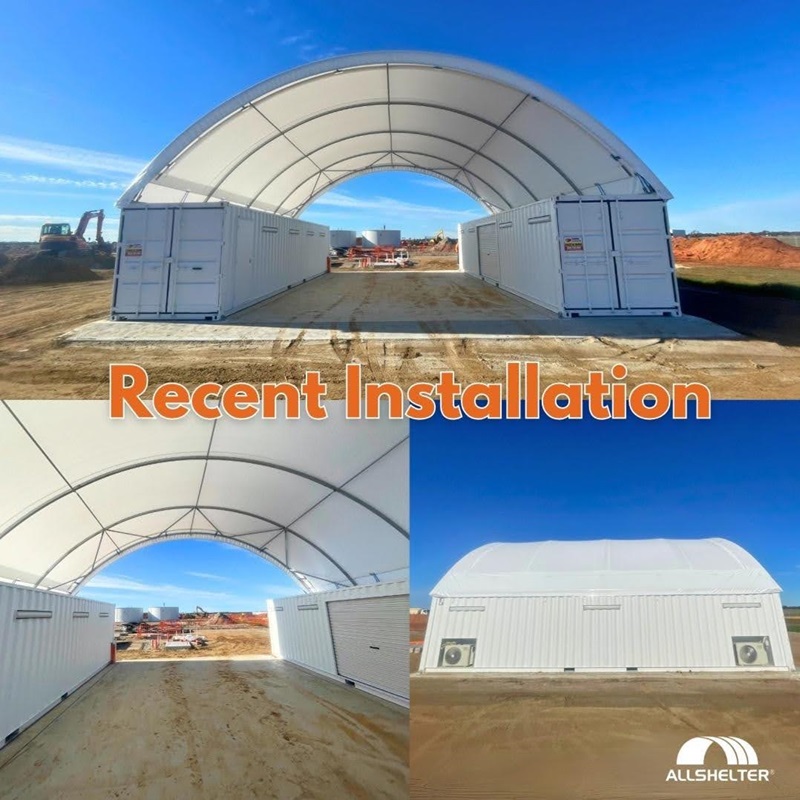
Most people in industrial work have stood near one without thinking much about it, a big fabric-sided structure at the edge of a yard, usually the same dusty cream or grey, housing something bulk and unglamorous. Fertiliser, grain, machinery, aggregate. Whatever needed a roof but didn’t need a postcode. They might house fertiliser, mining equipment, bulk grain, construction materials, or a fleet of machinery waiting for its next assignment. What they share in common is a practical logic that permanent construction simply can’t replicate when the requirement is speed or the need is temporary.
Fabric shelter technology has matured considerably over the past two decades. What once earned a degree of scepticism from site managers used to permanent structures has, through gradual proof of concept, become a mainstream solution across agriculture, mining, logistics, construction, and manufacturing. Today’s durable fabric shelters and modern container shelters are engineered solutions, not makeshift tarpaulins stretched over poles. They are engineered to withstand high winds, UV degradation, and the relentless punishment of industrial environments, and they are doing so whilst quietly transforming the way businesses think about storage capacity.
The Evolving Landscape of Industrial Storage
Industrial storage has always been a problem of competing pressures. On one side sits the need for protection, from weather, theft, contamination, and physical damage. On the other sits cost, and beneath that sits time. A mining company that discovers it needs additional aggregate storage by the end of the wet season cannot wait fourteen months for a concrete building to be approved, engineered, and constructed. A logistics operator expanding into a new distribution zone may not want to commit to a permanent structure when market dynamics could shift the need within three years.
For decades, the compromise was often a standard steel portal-frame shed. These structures solved many problems, but they brought their own: lengthy lead times, significant upfront capital, limited flexibility once erected, and the regulatory burden of permanent construction approvals. In environments where terrain was uneven, access was remote, or the footprint of operations was likely to shift, the portal-frame shed was an imperfect answer to a dynamic question.
What Makes a Fabric Shelter ‘Durable’?
‘Durable’ is a word that earns scrutiny here, because early fabric buildings didn’t deserve it. Early commercial fabric buildings used woven polyethylene or basic PVC membranes that degraded within a few years under sustained UV exposure, lost tensile strength in high-temperature conditions, and proved prone to tearing along seam lines. Those limitations, well-remembered by older industry professionals, have coloured perceptions of the technology in ways that no longer reflect current reality.
Structural Frame Systems
The membrane is only one part of the equation. The structural frame, typically galvanised steel or hot-dipped galvanised aluminium, depending on span and application, must be engineered to transmit wind and imposed loads into the ground anchoring system without transferring excessive stress to the fabric itself. In modern designs, this is achieved through carefully calculated pre-tensioning of the membrane, which stiffens the overall structure and distributes loads across the full surface rather than concentrating them at connection points.
Leading manufacturers design their frames to be fully engineered to local wind and snow load codes, producing certified drawings with each installation. In Australia, the benchmark reference is the ABCB Standard for Temporary Structures, which sets technical requirements for structural safety, wind actions, and fire performance, and which reputable suppliers should be able to demonstrate compliance with as a minimum. In regions prone to cyclonic activity or severe storm events, an uncertified structure is both a safety liability and a potential insurance void. Reputable fabric shelter suppliers provide documentation demonstrating compliance with relevant structural standards, and buyers operating in exposed locations should insist on this as a baseline.
The Efficiency Case: Why Industrial Operators Are Making the Switch
Industrial operators think about storage efficiency differently depending on what’s kept them up at night; it might be cost, or it might be the time a new contract started before the shed was ready. It encompasses capital efficiency, time efficiency, operational flexibility, energy use, maintenance burden, and the less-tangible but very real cost of disruption when storage arrangements need to change. Fabric shelters perform well across all of these dimensions, and understanding precisely how helps clarify why their adoption is accelerating.
Capital Cost Advantages
Industry experience points to fabric structures landing at roughly 30 to 60 per cent of the cost of a comparable steel-portal building, a range wide enough to reflect genuine variation in spec and site conditions, but consistently far enough below conventional construction to change the financial conversation. This is not merely a consequence of cheaper materials; it reflects the fundamentally different construction logic of a tensioned fabric structure.
Concrete foundations are generally not required. Instead, fabric shelters anchor via ground screws, driven anchors, concrete footings at frame bases, or in some cases ballasted foundations that can be installed without excavation. The elimination of a concrete slab, which for a large industrial shed can account for a substantial proportion of total project cost, changes the economics significantly.
Speed of Deployment
If capital cost is the primary driver for some operators, speed is equally compelling for others. A fabric shelter of modest size, say, 15 metres wide by 30 metres long, can typically be erected by an experienced crew within two to three days. Larger structures spanning 30 or 40 metres might require a week to ten days for a complete installation. Compare this with the six-to-twelve-month construction timeline of an equivalent permanent structure and the implications become stark.
For mining operations racing to establish wet-season stockpile cover, for agricultural enterprises needing grain protection ahead of harvest, or for logistics operators responding to a new contract with an immediate space requirement, this speed differential is not an abstract benefit, it is the difference between a workable solution and a problem that has already become a crisis by the time the building is ready.
Relocatability and Operational Flexibility
Perhaps the most strategically significant advantage of fabric shelters for modern industrial operators is relocatability. A permanent building, once erected, becomes a fixed asset tied to a specific location. If operations shift, as they frequently do in mining, agriculture, and construction, the building either stays behind (becoming a sunk cost) or is demolished (becoming a loss).
A quality fabric shelter, by contrast, can be dismantled by the same type of crew that erected it and trucked to a new location. Frame components are bolted rather than welded, foundations are reversible, and the membrane, if properly maintained, can serve across multiple deployments. This transforms the capital classification of the asset, from a fixture attached to land, to a piece of plant that moves with the business.
Sector-Specific Applications and Outcomes
The versatility of durable fabric shelters is evident in their spread across industries. Rather than serving a single niche, they have found application wherever the combination of large clear-span space, weather protection, and cost efficiency creates value, which turns out to be a very broad set of industrial circumstances.
Mining and Resources
The resources sector has become one of the most significant adopters of fabric shelter technology, and for logical reasons. Mining operations are frequently located in remote areas with limited access to construction labour and materials. They often operate on leases that do not justify permanent infrastructure investment. They may involve processing or storage activities that need to scale rapidly in response to commodity market conditions.
Fabric shelters in mining applications typically cover stockpile material, coal, iron ore, bauxite, mineral sands, to reduce moisture absorption and minimise dust generation. The environmental and regulatory benefits here are real: wet stockpiles can significantly affect product quality and handling efficiency, while uncovered stockpiles in exposed locations generate dust plumes that may trigger regulatory intervention. A fabric shelter that solves both problems simultaneously delivers value that extends beyond simple weather protection
Agriculture and Grain Storage
Agricultural applications for fabric shelters are extensive and, in many farming communities, now regarded as standard practice rather than innovation. Grain storage represents the most obvious use case: the ability to provide temporary or semi-permanent grain covering capacity at a fraction of the cost of steel silos or permanent sheds has transformed on-farm storage economics for many grain producers.
Livestock protection shelters, hay and fodder storage, machinery housing for tractors and implements, and fertiliser storage are all well-established applications. The fabric shelter’s ability to be erected quickly in the lead-up to a harvest season and then modified or relocated in the off-season fits naturally with the cyclical rhythms of agricultural enterprise.
Logistics, Warehousing, and Distribution
The logistics and warehousing sector presents a somewhat different set of requirements from mining or agriculture. Goods being stored are typically higher-value and more diverse. Access requirements are more demanding, forklifts, pallet jacks, and vehicle movements are constant. And the duration of occupancy is often more predictable, making the comparison with permanent construction more directly competitive.
Construction and Civil Works
Construction sites have long used fabric structures for on-site storage of materials and equipment, but the application has become considerably more sophisticated. Large-span fabric shelters are now used as temporary workshops for off-site fabrication, as precast concrete curing environments, as waste sorting and management facilities, and as covered areas for sensitive operations that cannot be exposed to weather interruptions. The ability to create a large, clear-span, weather-tight working environment on a site of limited duration without the cost of a permanent building is a compelling proposition for civil contractors who calculate every overhead closely.
Environmental Performance and Sustainability Considerations
The sustainability case for fabric shelters is nuanced but generally favourable relative to permanent construction. The embodied carbon of a fabric structure, the carbon emitted during manufacturing and installation, is substantially lower than an equivalent steel or concrete building, primarily because far less material is used per square metre of enclosed space. The U.S. Department of Energy’s lifecycle analysis framework for buildings explains how these upstream emissions are calculated, and the material-intensity difference between fabric and conventional construction is significant under any credible methodology.
The translucent properties of some fabric membranes offer genuine energy efficiency benefits. Natural daylight penetrating through the fabric eliminates or significantly reduces the need for artificial lighting during daylight hours, a meaningful saving for operations running extended daylight shifts. Studies in comparable structures suggest that translucent fabric roofing can reduce daytime lighting energy consumption by 70 to 90 per cent compared with opaque steel buildings relying entirely on artificial lighting.
The Financial Analysis: Total Cost of Ownership
A rigorous evaluation of fabric shelter economics requires looking beyond the initial capital cost to a full total cost of ownership (TCO) comparison with alternatives over the intended operational period. When this analysis is performed properly, the results are typically very favourable for fabric structures, though the specific outcomes vary significantly by application, location, and operational requirements.
Consider a representative scenario: a logistics operator requires 1,500 square metres of covered storage at a distribution facility expected to operate for ten years. The capital cost of a fabric shelter in this configuration might be in the range of $180,000 to $220,000 fully installed. An equivalent steel portal-frame building might cost $400,000 to $550,000. The capital saving of roughly $200,000 to $300,000 is the starting point for the analysis.
Conclusion: The Quiet Revolution in Industrial Storage
Fabric shelter technology has earned its place in the industrial storage landscape through the accumulation of evidence rather than marketing enthusiasm. Across mining sites, grain farms, logistics precincts, and construction yards, these structures have demonstrated that they can deliver reliable, durable, and cost-effective covered space in circumstances where conventional construction either cannot compete on economics or simply cannot move fast enough to meet operational needs.
The technology is not without its limitations, it is not appropriate for every application, it requires informed specification and quality installation to perform as advertised, and it demands a maintenance commitment from operators who want to realise its full service life. But for the very large class of industrial storage problems where the requirements are clear-span space, weather protection, cost efficiency, and flexibility, a well-designed and properly installed fabric shelter is frequently the most rational choice available.
That shift is already well underway. The more practical question for most operations now isn’t whether this technology is proven; it is whether the case has been made internally, to the people who control the budget and sign off on the site plan. That’s a different problem, and a more familiar one.