Why Rope Access Is Replacing Scaffolding for High-Rise Painting on the Sunshine Coast
For building owners and body corporates managing a high-rise repaint on the Sunshine Coast, the access method is often the biggest cost driver — and the decision that gets the least scrutiny. Scaffolding has been the default for decades. But for most high-rise painting projects, it’s no longer the most practical or cost-effective option. Specialists in high rise painting Sunshine Coast are increasingly working exclusively via rope access — and the reasons why are worth understanding before you approve a quote.
What Scaffolding Actually Costs on a High-Rise
Scaffolding costs are rarely presented clearly in a painting quote. The scaffold hire itself runs $1,000–$5,000 per week depending on configuration and height. On a 10-storey building, access costs alone can exceed $27,000 before a brush hits the wall. Add engineer certification, council permits, footpath closure approvals and the time to erect and dismantle, and the access component of a scaffolded repaint becomes a substantial portion of the total project cost.
On the Sunshine Coast specifically, there’s an additional complication. Beachfront and esplanade buildings often have constrained sites — no kerb space, narrow footpaths, proximity to public areas. Staging scaffolding on these sites isn’t always possible, and where it is, the disruption to residents, ground-floor businesses and the surrounding area is significant.
How Rope Access Works
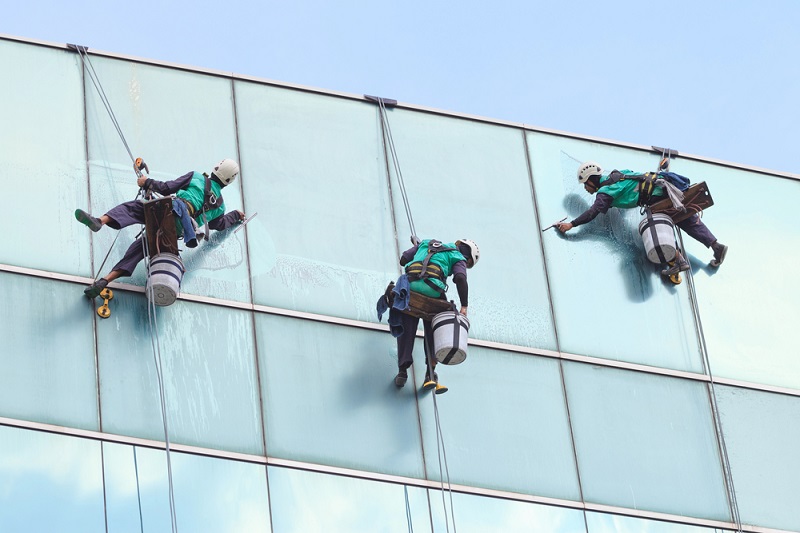
Rope access painting uses IRATA-certified abseilers working from anchor points on the roof. The team descends the building face on a rigging system, carrying out painting, surface preparation and application as they work down each elevation. There is no structure to erect or dismantle. Mobilisation is fast. The footprint at ground level is minimal — typically a safety exclusion zone below the working area.
For high-rise buildings, rope access isn’t a workaround. It’s the method that makes the most operational sense. There’s no scaffolding to work around, no staged sections that limit access to parts of the building, and no week-long setup process before painting can begin.
The Coastal Painting Problem Scaffolding Doesn’t Solve
Painting a high-rise on the Sunshine Coast isn’t the same as painting one inland. Salt air accelerates coating breakdown — particularly on north and east-facing elevations that take direct exposure off the ocean. Surfaces that haven’t been cleaned properly before repainting will fail prematurely regardless of the paint system used. Most major coating manufacturers, including Dulux, specify surface preparation standards that include thorough cleaning as a condition of warranty.
Here’s where rope access has a practical advantage that’s rarely discussed: most high-rise buildings have no water supply at balcony level. Pressure washing from an EWP or platform is impractical because the equipment can reach the elevation but the water supply can’t. Rope access operators work from the roof down, running pressure washing equipment from a rooftop water source. Proper surface preparation — the step that determines how long the paint system lasts — is only reliably achievable via rope access on a tall building.
Salt damage left on a facade before repainting doesn’t just affect adhesion. Chloride ions from salt penetrate concrete and attack steel reinforcement, accelerating the process known as concrete cancer. A repaint that doesn’t address the underlying contamination is painting over a problem, not solving it.
What to Look for in a Rope Access Painting Contractor
Not all rope access operators are equivalent. IRATA certification is the international standard for rope access technicians — it covers training, competency assessment and ongoing recertification. A team without IRATA certification is operating outside the recognised safety and competency framework for the industry.
Beyond certification, the relevant question is whether the contractor’s rope access capability is purpose-built or bolted on. Some painting companies subcontract the access component to a separate team. That creates a split in accountability — particularly when surface condition, preparation quality or coating application requires a judgement call on the day. A contractor whose abseilers are also the painters carries full responsibility for the outcome.
Licensing matters too. In Queensland, building work above a certain value requires a QBCC licence. Confirm the contractor holds the appropriate licence category before work begins.
The Practical Case
For a body corporate or building manager weighing up a repaint, the access decision comes down to a straightforward comparison. Scaffolding adds weeks to the programme, significant cost to the budget, and disruption to the site that rope access simply doesn’t create. On a coastal building where surface preparation is critical to the longevity of the coating, rope access is also the method that makes proper preparation possible.
The shift away from scaffolding on high-rise repaints isn’t a trend — it’s a reflection of what actually works on tall buildings in constrained, high-exposure environments. On the Sunshine Coast, that case is stronger than most markets.