5 Best Contractor Insurance Providers for Diverse Construction Projects
Construction work doesn’t fit a single mold, a roofer’s risk profile looks nothing like a road crew’s, and neither resembles a commercial framer’s. Finding the best contractor insurance providers for diverse construction projects means knowing which brokers and carriers can actually match coverage to the trades, project sizes, and state requirements contractors deal with every day.
The five options below cover a real range: from independent brokers who specialize exclusively in construction to national carriers with decades of commercial underwriting experience.
1. Affordable Contractors Insurance
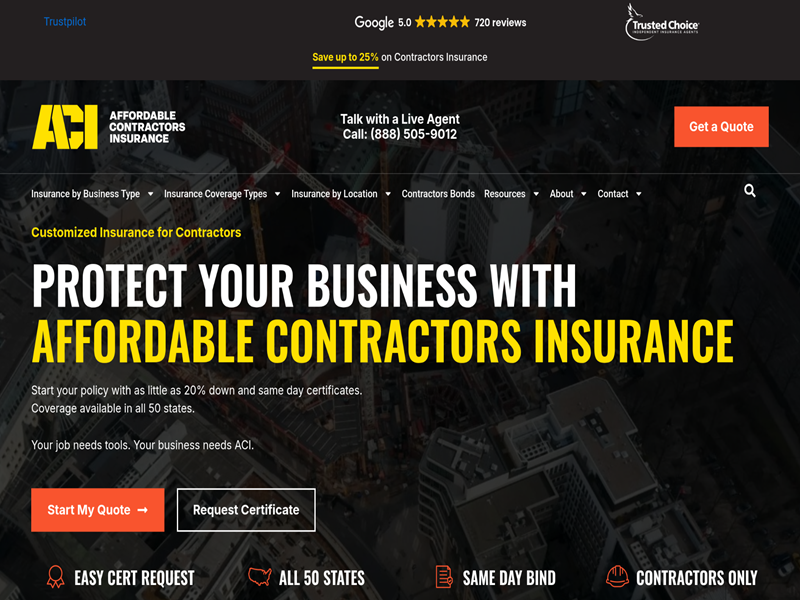
A veteran-owned, nationwide brokerage founded in 2011 that binds general liability, workers’ comp, and related coverage for construction contractors of any size, across all 50 states: with same-day policy binding and quotes generated in as little as 10 minutes.
- Coverage lines: General liability, workers’ compensation, commercial auto, builder’s risk, excess and umbrella, tools and equipment, professional and pollution liability, and contractor payment bonds
Policies start with as little as 20% down, with the remaining balance spread across monthly payments; savings of up to 25% on coverage are site-stated. The brokerage has no published minimum revenue requirement and serves solo tradespeople through multi-million-dollar firms. Same-day policy binding is available, with most certificates of insurance issued within 24 to 48 business hours and same-day turnaround for urgent project deadlines. Affordable Contractors Insurance holds 4.9 out of 5 stars across 1,676 combined Trustpilot and Google reviews and is a Trusted Choice member agency (profile #10023324).
2. Genrose Insurance
An independent broker based in Scottsdale, Arizona that represents dozens of carriers across health, liability, and business lines, working on behalf of the client rather than any single insurer.
- Coverage lines: General liability, group and individual health, dental, vision, disability, life, auto, home, and business insurance
Genrose is licensed in 13 states including Arizona, California, Texas, New York, Washington, and Colorado. It specializes in small businesses, positioning itself as an advocate that shops multiple carriers to find competitive pricing. Quotes are not publicly listed and are customized to individual needs and budgets. Genrose was awarded $10,000 to Make-A-Wish Arizona (June 2025) following an online voting campaign and has been BBB-accredited since April 2020 with an A+ rating. Contractors working across a wider multi-state footprint may need to look elsewhere, as Genrose operates in 13 states.
3. Liberty Mutual
Your content goes here. Edit or remove this text inline or in the module Content settings. You can also style every aspect of this content in the module Design settings and even apply custom CSS to this text in the module Advanced settings.
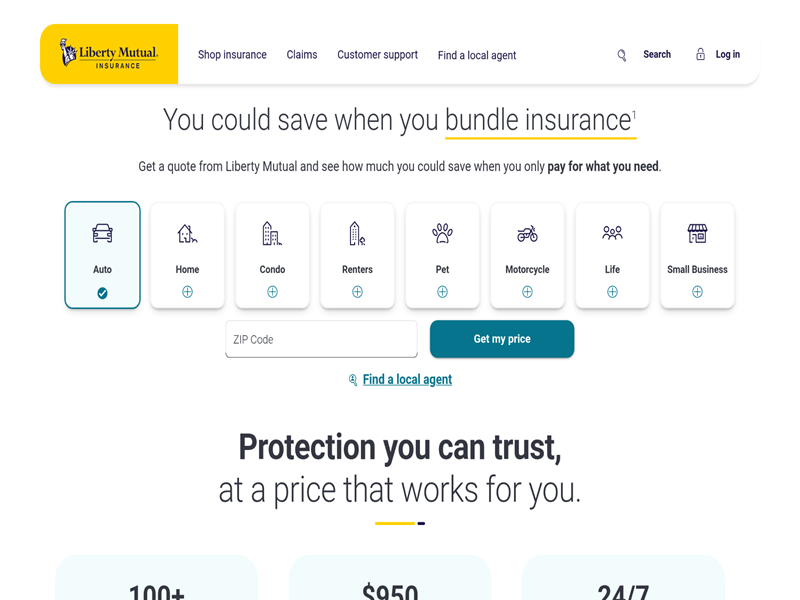
A Fortune 100 insurer and the sixth-largest property and casualty carrier in the world, offering commercial coverage through its Global Risk Solutions unit alongside a broad personal lines network.
- Coverage lines: Commercial general liability, commercial auto, workers’ compensation, commercial multiple peril, global specialty, fire, and surety
Liberty Mutual employs more than 45,000 people across 900-plus locations worldwide and distributes through a network of more than 2,300 sales professionals. Its Global Risk Solutions unit handles specialty commercial products including marine, energy, aviation, and professional liability through 40 international offices. Full-coverage auto averages 238permonth(2,861 per year), which Liberty Mutual’s own data places 21% above the national average, a useful benchmark for cost-sensitive buyers comparing personal and commercial lines. Liberty Mutual was named a 2026 Best Place to Work by Built In across multiple markets and earned a 2025 Corporate Citizenship Award from the Boston Business Journal.
- Considerations: Premium pricing tends to run higher than independent brokerage alternatives; contractors seeking the most competitive rates may find better value through a broker that shops multiple carriers
4. AmTrust Insurance
A New York-based multinational property and casualty carrier that is the third-largest provider of workers’ compensation in the country, with more than 500,000 small commercial policies in force.
- Coverage lines: Workers’ compensation, general liability, business owners policies (BOP), cyber liability, and employment practices liability (EPLI)
AmTrust’s Small Commercial Business segment targets low-to-medium hazard classes such as restaurants, retail, and professional offices, and extends into construction-adjacent commercial accounts. Its AmTrust Genius platform accelerates quote generation for brokers and agents. Published pricing benchmarks include BOP at $57 per month, general liability at $42 per month, and workers’ comp at $45 per month, among the more transparent published benchmarks in this category. AmTrust posted 2024 revenue of $5.81 billion and holds an A? (Excellent) rating from AM Best. The carrier was named a 5-Star Claims Excellence standout by Insurance Business America in 2025.
- Considerations: AmTrust went private in November 2018 and delisted in January 2019, which limits the public financial transparency some large clients prefer.

A Chicago-based commercial insurance holding company with roots going back to 1853, recognized as one of the largest commercial insurers in the United States, with a dedicated construction customer segment.
- Coverage lines: Commercial property, marine, boiler and machinery, workers’ compensation, general and product liability, commercial auto, umbrella, and excess and surplus
CNA introduced a formal construction customer segment in 2011, meaning underwriters work with construction risk, not just general commercial accounts. The company operates through independent agents, brokers, and managing general underwriters rather than direct-to-consumer sales. CNA has 6,600 employees as of December 31, 2025, is backed by more than 125 years of experience, and is 90% owned by Loews Corporation. CNA’s brands include Hardy Underwriting Bermuda Limited, covering professional liability, management liability, and specialty lines. Rates are not publicly listed and are determined case-by-case for commercial clients.
- Considerations: CNA is a business-to-business carrier; contractors cannot obtain a direct quote and must work through an agent or broker.
Coverage types that matter across construction work
No single policy type can carry all the risk on a construction project, the work varies too much for that. General liability is the baseline most states require, and nearly every project owner demands proof of it before a contractor sets foot on site. It covers third-party bodily injury and property damage. Workers’ compensation picks up employee injuries on the job.
Those two policies still leave real gaps. Builder’s risk protects the structure and its materials while construction is active. Commercial auto covers work trucks and vans. And tools and equipment coverage – often the first thing contractors forget – addresses theft or damage of jobsite gear that general liability won’t touch.
For contractors doing environmental work or offering design-build services, professional and pollution liability fills a gap that a standard GL policy leaves wide open. And when a claim pushes past the limits of a baseline policy, excess and umbrella coverage absorbs the overflow.
Matching insurers to your project scope
The right fit depends on trade, project type, and how quickly a contractor needs coverage active. A solo electrician in one state has different needs than a mid-size roofing company working across four states.
Independent brokers, including those that work with dozens of carriers simultaneously, tend to give smaller contractors more pricing options than going direct to a single carrier. And the best contractor insurance providers for diverse construction projects aren’t always the biggest names; they’re the ones that understand trade-specific exposures, can bind coverage on short notice, and know the regulatory requirements in every state where the contractor works.
Speed matters more than it used to. A general contractor who lands a job Monday and needs a certificate of insurance to the project owner by Tuesday can’t afford a multi-day underwriting delay.
Bottom Line
Construction insurance isn’t a commodity purchase. Trade type, project size, state licensing requirements, and how fast a policy needs to bind all shape which direction to go. National carriers like CNA and Liberty Mutual bring deep commercial underwriting experience and broad specialty lines. AmTrust stands out for its published pricing transparency and its track record in small commercial workers’ comp. Genrose works well for small businesses inside its 13-state footprint who want broker-style carrier shopping. For contractors who need fast coverage – any size, any state – independent brokers with no revenue floor and same-day binding capabilities are often the most practical starting point.