Compliance 101: Keep Your Industrial Shed Up to Australian Safety Standards
If you’re running an industrial shed in Australia, you already know that the paperwork can be a nightmare. But beyond the red tape, there’s a real-world responsibility to make sure the blokes on the floor actually go home in one piece at the end of the shift.
Australian safety standards aren’t just suggestions; they are the law, and if you’re cutting corners on things like dust control or height safety, it’s only a matter of time before it catches up with you.
In 2026, the regulators aren’t just looking for a first-aid kit and a fire extinguisher. They’re looking at the systemic ways you manage a high-risk environment.
Managing the “Invisible” Hazards: Dust and Debris
Most people think of a messy shed as just a bit of a nuisance, but in an industrial setting, a dirty floor is a compliance failure. We’re talking about “fine particulate matter”—that invisible dust from sanding, grinding, or sawing that hangs in the air long after the machines have stopped.
Under current WHS guidelines, you’ve got a legal duty to keep that air clean. You can’t just hand someone a broom and a cheap mask. Sweeping often just kicks the smallest (and most dangerous) particles back up into the breathing zone.
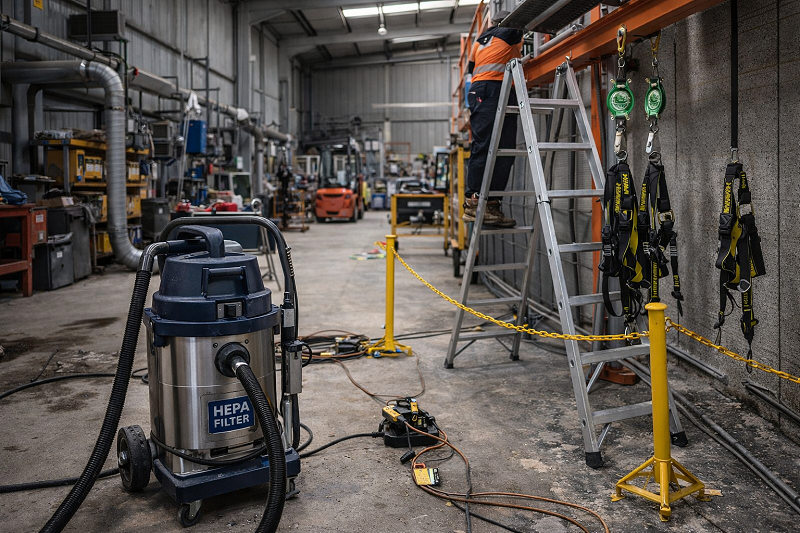
This is why you’ll see most compliant shops moving toward high-spec commercial vacuum cleaners.
If you look at the gear from AC Cleaning Supplies, the focus is on HEPA filtration. That’s the gold standard for a reason. It actually traps the microscopic stuff that causes long-term lung issues.
From a compliance perspective, showing that you’ve invested in proper machinery to manage silica or timber dust is a massive tick in the “due diligence” box. It proves you aren’t just paying lip service to worker health.
Working at Heights: Don’t Risk the “She’ll Be Right” Attitude
Height safety is where a lot of shed owners get caught out. Because a shed feels “enclosed,” people get a false sense of security.
But, the moment someone climbs a ladder to fix a light fitting or clear a gutter, they’re in a high-risk zone. If that roof is more than two metres up, you’re playing with fire if you don’t have a plan.
The Australian Standards (AS/NZS 1891) are pretty black and white about this. You need a system.
However, for a lot of small-to-medium businesses, buying a whole suite of permanent anchors and harnesses for a job that happens twice a year doesn’t make financial sense.
That’s where Conveying & Hoisting Solutions comes in handy. Using height safety systems on a rental basis is a smart move for compliance. It means you’re getting gear that is fresh, fully inspected, and tagged according to the latest Aussie standards.
You don’t have to worry about whether a harness has been sitting in the sun for three years losing its strength—you get the right kit for the specific job, you do the work safely, and you send it back. It keeps the site legal without the massive overhead.
The “Must-Dos” for a Compliant Shed
If you want to stay off the radar of the inspectors, there are a few things that need to be non-negotiable:
- Trip Hazards: It sounds basic, but pallet wrap and loose cables are the leading cause of injuries. If the floor isn’t clear, it isn’t compliant.
- Air Quality Logs: Don’t just clean; keep a record of it. If you’re using professional vacuums, note down the filter changes. It’s evidence of your safety culture.
- Testing and Tagging: Every lead in that shed needs a current tag. If an inspector sees an out-of-date tag on a power tool, they’ll start looking much closer at everything else.
- Clear Access: Those “Working at Height” zones need to be clearly marked. If someone is on the roof, the area below should be cordoned off. No excuses.
Why Bother? (Beyond the Fines)
Yeah, the fines are huge, but that’s not the only reason to stay on top of this.
A compliant shed actually runs better. When you use decent commercial vacuum cleaners, your expensive machinery doesn’t get clogged with grit and break down.
When your team knows they have the right height safety systems from Conveying & Hoisting Solutions, they work with more confidence. They aren’t tiptoeing around, worried about a slip.
In the end, it’s about professionalism. An industrial shed that looks and acts like a compliant workspace attracts better staff and better clients. It shows you’re a serious operator who values their people and their reputation.
Take a look around your floor today. If it’s thick with dust or your height safety plan is just “be careful,” it’s time to make a few calls and get things up to scratch. It’s much cheaper than the alternative.
Common questions we hear from Australian businesses
How often should an industrial shed review its safety controls?
Usually, a meaningful review happens when work changes (layout, equipment, tasks) and on a regular cycle that matches your risk profile. A practical next step is to schedule a quarterly walk-through focused only on height exposure, vehicle routes, and housekeeping, then log actions with owners. In Australia, this works well because many sites experience seasonal peaks and contractor bursts that quietly change risk.
Do we need fixed height safety systems, or can we use temporary solutions?
It depends on how frequent and predictable your at-height tasks are, and how much supervision you can reliably provide. A practical next step is to list your at-height tasks for the next 12 months and mark which are routine versus one-off, then choose controls that match those patterns. In most cases, Australian sheds with mixed maintenance needs end up using a baseline approach plus temporary measures for unusual jobs.
What’s the biggest compliance gap you see with contractors?
In most cases, it’s unclear ownership of the plan on the day—scope drifts, site rules aren’t reinforced, and supervision becomes assumed. A practical next step is to assign a named site contact for every contractor job and require a short pre-start confirmation that matches the actual work area. In Australia, where multiple trades often overlap during shutdowns, this single step can prevent a lot of “we thought they were handling that” confusion.
How do we improve housekeeping without turning it into a daily argument?
Usually, housekeeping improves when it’s tied to production flow instead of being framed as a cleanliness preference. A practical next step is to define three “non-negotiable” housekeeping standards (egress clear, spill response time, no storage in walkways) and build them into shift handover checks. In most cases, Australian industrial sheds see better uptake when supervisors can point to a simple standard rather than an open-ended instruction to “keep it tidy.”