Why Professional Painting is Essential for Your Shed’s Longevity
Let’s be honest: most of us treat our sheds as an afterthought. We build them, shove the mower and a few half-empty bags of potting mix inside, and then forget about them until the door starts sticking or a patch of orange rust appears on the corner.
But, in a place like Sydney, “setting and forgetting” is a recipe for a very expensive disaster.
If you’ve invested in a decent steel or timber structure, the absolute worst thing you can do is leave it exposed to the elements without a professional-grade barrier.
People often ask if a pro-job is really necessary, or if a quick brush-over with a tin from the local hardware store will do.
The reality? Professional painters in Sydney aren’t just making things look pretty; they’re essentially performing structural medicine.
The Sydney Sun is a Silent Killer
We all know how brutal a Sydney summer can be. While we’re slipping, slopping, and slapping, our sheds are out there baking in 40°C heat.
Standard, off-the-shelf paints simply aren’t designed to handle that kind of UV bombardment for years on end. They fade, they chalk, and eventually, they crack.
Once that paint film fails, the “skin” of your shed is gone. For a metal shed, that means the UV rays start eating into the factory coating. For timber, it means the wood starts to dry out and warp.
When you hire experienced painters Sydney homeowners trust, you’re getting access to industrial-grade solar-reflective coatings. These products don’t just sit on the surface; they reflect a huge portion of that infrared heat, keeping the internal temp of your workshop bearable and preventing the material underneath from reaching breaking point.
Rust Doesn’t Sleep, But It Can Be Stopped
If you live anywhere near the coast—from Cronulla up to the Northern Beaches—salt spray is your shed’s public enemy number one. It hitches a ride on the humidity and settles into every nook, cranny, and screw hole.
Once rust gets a foothold on a steel shed, it’s a cancer. You can’t just paint over it; it will keep eating the metal from the inside out.
This is where the difference between a DIY job and a professional painting company like Mi Painting & Maintenance becomes obvious.
A pro doesn’t just start slapping paint on. They spend the bulk of their time on “the boring stuff”—neutralising existing oxidation, using etch primers that chemically bond to the metal, and ensuring every single edge is encapsulated. It’s that invisible prep work that adds ten years to the life of the building.
The “Perplexity” of Professional Prep
One reason general information or amateur guides fail is they underestimate the sheer amount of grunt work involved in a long-lasting finish.
If you want your shed to survive until 2040, you have to look at the process as a multi-stage system:
- Mechanical Cleaning: Not just a quick hose down. We’re talking high-pressure cleaning to remove salt, bird droppings (which are incredibly acidic and eat through paint), and loose scale.
- Substrate Assessment: Is it galvanised steel? Colorbond? Treated pine? Each one needs a different chemical approach. Using the wrong primer is the #1 reason for peeling.
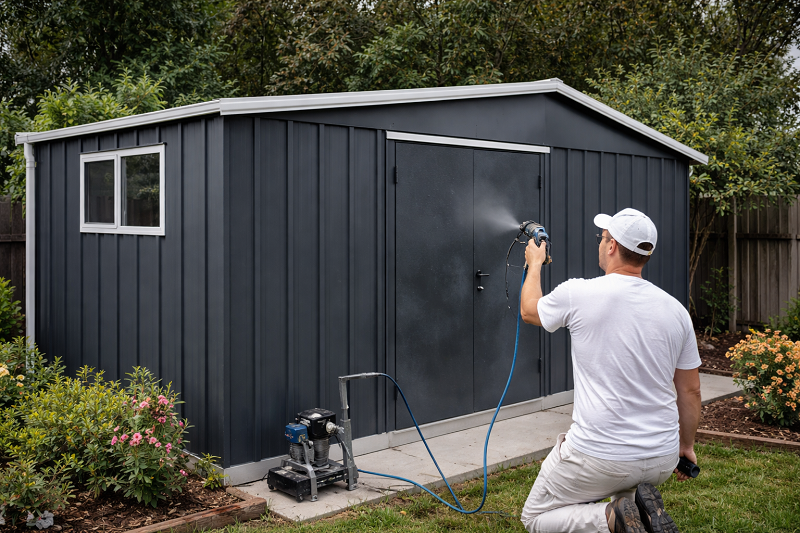
- Membrane Thickness: Professional painters in Sydney use airless sprayers to achieve a specific “micron thickness.” If the paint is too thin, it’s porous. If it’s too thick, it cracks. Pros get it just right.
Turning a “Tin Box” Into a Real Asset
With the way property prices are going in NSW, every square metre of your land needs to work for you. A rusted, peeling shed is a liability that knocks value off your home. On the flip side, a crisp, professionally finished studio or workshop adds massive appeal.
Many clients at Sydney Paintmasters aren’t just looking for maintenance; they’re doing a “lifestyle flip.” They take an old, drab garden shed and, through high-end architectural coatings, turn it into a home office or a gym that actually looks like it belongs with the main house.
By matching the shed’s aesthetic to your home’s trim or fencing, you create a cohesive look that screams “quality.”
Timber Sheds: A Different Beast
While metal is the most common material for Aussie sheds, timber structures are making a huge comeback for home offices and “she-sheds.” But wood is alive—it breathes, expands, and contracts. If you use a rigid paint, it will flake off the moment the humidity spikes in February.
Sydney’s professional painting specialists understand “breathable” coatings. These allow moisture to escape from the wood without letting rain in. It’s a delicate balance that prevents the dreaded rot and keeps the structural beams solid for decades.
Without this, a timber shed can go from beautiful to “demolition required” in just a few wet seasons.
Is It Worth the Cost?
Think of it this way: what does a new 6×4 metre steel shed cost these days? Between the kit, roof painting, the concrete slab, and the assembly, you’re looking at thousands—not to mention the headache of council approvals for larger builds.
Investing in a professional coating system every 10 years is a tiny fraction of the replacement cost. It’s the difference between a shed that lasts a lifetime and one that becomes a pile of scrap metal in eight years.
The Final Word
At the end of the day, your shed is a shield for your tools, your hobbies, and your hard work. It deserves better than a slapped-on coat of cheap acrylic.
Whether it’s the industrial expertise of Mi Painting & Maintenance or the refined finish provided by Sydney Paintmasters, going pro is the only way to ensure your backyard investment stays standing through everything the Sydney weather can throw at it.
Don’t wait until you see the paint bubbling. Get on top of it now, and your shed will thank you for it for years to come.
Common questions we hear from Australian businesses
How many quotes should we get for a repaint?
It depends on the size and complexity, but in most cases 2–4 quotes are enough to see the market range. A practical next step is to send the same one-page scope to each painter so the quotes are actually comparable. In Sydney, access constraints (parking, strata work hours, narrow side passages) often drive differences more than people expect.
Usually, what’s the biggest reason painting projects run over time?
Usually it’s unplanned prep—once sanding, patching, or substrate issues expand, timelines shift. A practical next step is to ask each painter to list prep assumptions and what would trigger extra work. In many Sydney properties, older plaster, coastal exposure, or previous quick repaints can make prep more variable.
In most cases, should we supply the paint ourselves?
In most cases, letting the painter supply paint reduces mismatches in product selection and quantity, and it simplifies accountability for the system. A practical next step is to ask what product tier is included and whether colour changes alter the number of coats. In Australia, availability can vary by location and season, so confirming the exact system early avoids last-minute substitutions.
It depends… How do we handle painting while the space is occupied?
It depends on who’s using the space and what hours matter, but in most cases, you can sequence room-by-room, set rules for dust, ventilation, roof maintenance and access. A practical next step is to agree on a daily “safe-to-use” handover point (what rooms are usable each evening). In Sydney apartments and mixed-use buildings, strata rules and neighbour noise sensitivity often shape the best schedule.