Caravan Camping in Australia for Beginners: What to Know Before Your First Trip
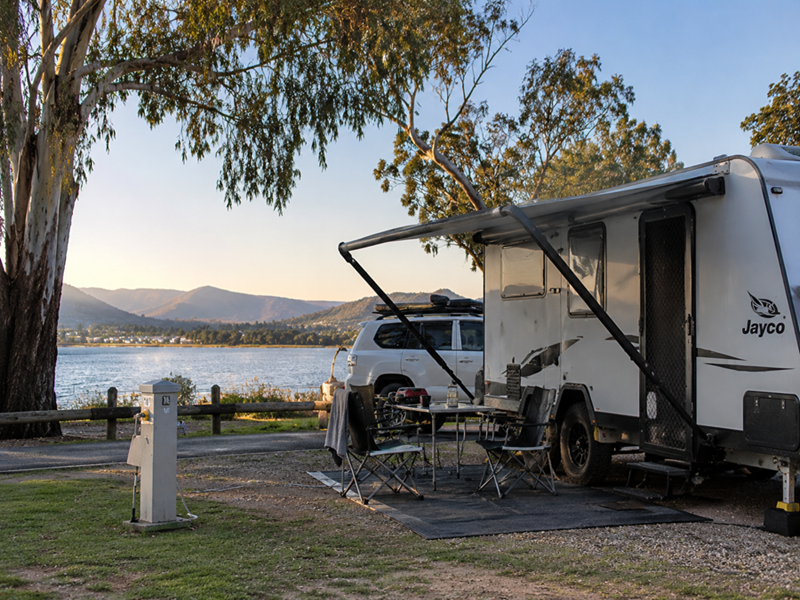
A caravan can be perfectly legal on its own and still be over the limit behind your car. A campsite can look roomy in the photos and turn out to be impossible to back into. Most first-timers find this out at dusk, on a tight site, with other campers watching. Better to learn it close to home, with a weekend at a caravan park a few hours away, in a hired van if you’re not ready to buy.
The van has to suit the car, not the other way round
Start with the owner’s manual, not the caravan yard. You’re looking for four numbers: towing capacity, towball limit, gross vehicle mass (GVM) and gross combination mass (GCM).
GCM is the one that trips people up. Western Australia’s Safe Towing Guide points out that it can be lower than GVM and towing capacity added together, and its worked example has a fully loaded car pulling a fully loaded trailer and finishing 390 kg over the limit.
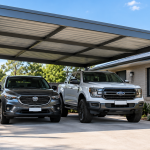
Then there’s towball download, the weight pressing down on the hitch, which counts towards the car’s GVM. A common guide is 8 to 10 per cent of the van’s aggregate trailer mass (ATM), without going over the towbar’s rating. Heavy gear goes low and close to the van’s axles. A public weighbridge will tell you where the whole rig sits. Ute owners can see the same limits from a work-vehicle angle in ShedBlog’s guide to setting up a Ford Ranger.
Licence rules for towing differ between states and territories, so check yours with your transport authority before you hire or buy.
Picking campsites your van can actually reach
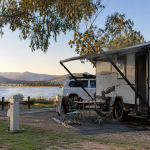
Caravan parks are the easy first step, with power, showers and a dump point for the toilet cassette. National parks take more work. The listing photos show the view, but they rarely show the access road. At Lake Catani on Mount Buffalo, Parks Victoria says the campground suits vans no bigger than about four metres, because the tracks are narrow and the turns are tight. Many family caravans are longer than that.
Signal, data and what happens when they run out
Your phone does most of the navigating and permit-holding on a trip like this, which is fine until the signal goes. Away from towns it can vanish for long stretches, so save offline maps and bookings while you have it.
If you’re visiting from overseas, an international SIM card or travel eSIM saves you paying home roaming rates every time you look up a campsite or the next fuel stop. It still depends on local networks, though, and where none of them has signal it won’t connect either. Holafly’s Australia eSIM, for example, runs on Optus only and is data only, with no Australian number, which matters if a caravan park wants to text you. Check that your phone is unlocked and eSIM-compatible before you fly.
If your own network is down but another Australian network has coverage, a compatible phone can still get through to 000. With no network at all, it can’t, and dialling 112 won’t help. Some phones bought overseas may also struggle to call 000 on Australia’s 4G networks now that 3G has been switched off, so ask your provider before relying on yours. If you’re heading off the main roads, carry a personal locator beacon and register it.
Towing on long Australian roads
Towing wears you out faster than ordinary driving, so plan more rest stops and shorter days. Leave more room in front, and drop a gear on long descents. When a truck comes past, ease off, because the wind it pushes can shove the van sideways. If the van starts to sway, don’t brake the car. Keep the steering and accelerator smooth instead.
Towing speed limits vary by state. In WA you can’t go over 100 km/h with a trailer on, even where the signs say more.
Stop soon after you set off to check the coupling, chains, lights and tyres, then check again at rest stops along the way. While you’re there, hold the back of your hand near each caravan wheel. If one is much hotter than the others, you may have a sticking brake or a bearing on its way out.
Setting up at the end of the day
Try to roll in before dark. Backing onto a site is much easier with someone standing behind the van, using hand signals you’ve agreed on beforehand. Look up for loose or overhanging branches before you unhitch. Campfires are often limited to designated fireplaces and banned on total fire ban days, so check before lighting one.
Before you leave, turn the gas off, latch the windows and roof hatches, wind up the stabilisers and walk once around the van. That last lap is the one that finds the open hatch.