How Bulk Water Access Works for Construction and Mining Projects in Australia
Mining and construction projects rely heavily on a consistent and high-volume water supply to ensure efficient operations. In many countries, access points such as a standpipe Australia network provide a key source of bulk water for industrial use, particularly for tanker filling and remote site supply. However, the matter is not simply about having water available. Instead, bulk water access functions as an integrated system in which water is stored and distributed across multiple activities on site.
The real value of bulk water access becomes clearer when viewed through its role in day-to-day operations. Rather than focusing solely on supply, it is more useful to examine how water moves through a project and supports its most critical functions. To that end, the sections below explore how bulk water access works in practice, highlighting the key ways it enables construction and mining activities across Australia.
Controls Dust Levels and Maintains Air Quality Across Active Sites
Dust suppression represents one of the most immediate and continuous uses of bulk water on both construction and mining sites. Activities such as drilling and blasting release fine particles into the air, which can reduce visibility and negatively impact worker health. Excess dust can also drift towards nearby communities and cause various issues.
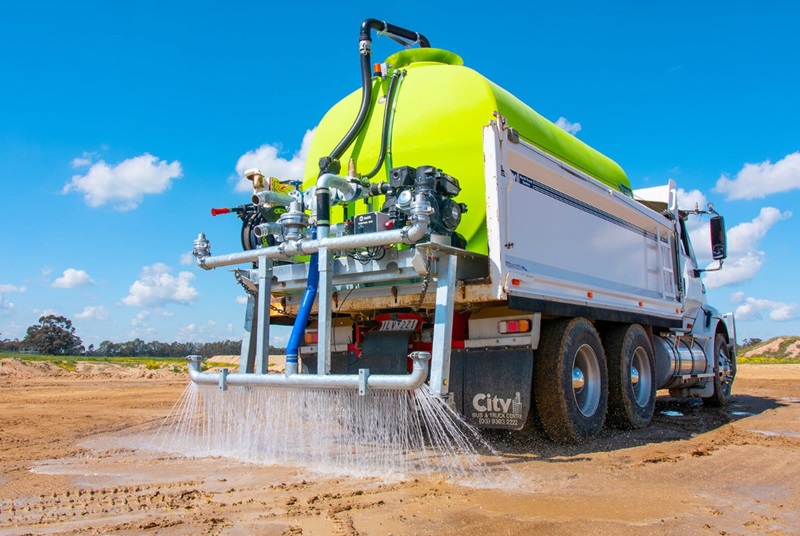
To address this, operators rely on a coordinated system of spray bars and fixed pipeline networks that distribute water across roads and active work zones. These systems draw from central storage facilities, such as tanks and site dams, providing a steady supply that teams can easily access even during periods of intense activity.
There’s also a need to adjust application rates based on weather conditions, soil type, and traffic levels to ensure that water use remains efficient while still achieving effective dust control. This continuous and responsive distribution, enabled by reliable water access, improves air quality and supports compliance with environmental standards.
Supports Material Processing and Enables Consistent Production
Water plays a central role in material processing, particularly in mining, where it supports several core functions. It enables the washing of ore and facilitates the movement of slurry through pipelines, while also supporting the separation of valuable minerals from waste materials. These processes depend on a reliable and pressurised water supply, which workers deliver through pumps and controlled distribution systems connected to processing plants. Without this level of coordination, processing efficiency would decline, and production targets would become difficult to achieve.
Although its applications differ, water is equally important in construction. Concrete production, for instance, requires precise water ratios to ensure strength and durability. Meanwhile, soil compaction depends on adequate moisture levels to achieve stability. In both cases, operators direct water to specific work areas through hoses or temporary pipelines.
Many construction sites also incorporate recycling systems that capture runoff or used water, treat it as necessary, and return it to the system. This approach reduces overall consumption and ensures that water remains available for continuous production activities.
Regulates Equipment Temperature and Supports Ongoing Maintenance
Heavy machinery and industrial equipment generate significant heat during operation, particularly in mining environments where processing plants run continuously. In these environments, bulk water access supports cooling systems that regulate temperatures in crushers, mills, and generators. These systems circulate water through equipment to absorb heat and maintain safe operating conditions, which in turn prevents overheating and potential damage.
In addition to cooling, water also supports regular maintenance. Workers use hoses and pressure systems to clean machinery, removing dust and residue that accumulate over time. This cleaning process helps maintain efficiency, as buildup can interfere with moving parts and reduce performance. Furthermore, consistent maintenance supported by reliable water access extends the lifespan of equipment, reducing the likelihood of unexpected breakdowns and lowering associated costs.
Sustains Workforce Needs and Keeps Site Facilities Operational
Large-scale projects often involve a substantial workforce, and many sites operate in remote locations where municipal water infrastructure is inaccessible. Consequently, bulk water systems must also support daily human needs, including hydration, sanitation, and food preparation. To ensure safety, operators separate potable and non-potable water supplies, storing them in different tanks and distributing them through dedicated pipelines.
This separation allows teams to maintain strict hygiene standards while still using non-potable water for industrial purposes. In addition, consistent water access supports accommodation facilities, such as site camps. These systems need to operate continuously, so as to maintain both productivity and worker wellbeing.
Strengthens Fire Prevention Measures and Supports Emergency Response
Fire risk remains a constant concern in construction and mining sites due to the presence of fuel, heavy machinery, and electrical systems. For this reason, bulk water access forms a key part of fire prevention and emergency response strategies. Operators store water in dedicated reservoirs or tanks, connected to pumps and mobile firefighting units positioned across the site, ready for immediate use. In the event of a fire, teams can quickly access and deploy water to contain the situation and protect both personnel and infrastructure.
Maintaining adequate reserves ensures that fire response does not interfere with other operational water needs. This level of preparedness highlights how water systems must balance routine use with emergency readiness, ensuring that sites remain safe under a range of conditions.
It’s More Than Just Supply
Bulk water access in construction and mining projects across Australia functions as far more than a simple supply chain. Instead, it operates as a coordinated system that underpins essential activities ranging from dust control and material processing to workforce wellbeing and emergency preparedness.
As projects grow in scale and complexity, effective water management becomes increasingly important. Reliable access and efficient distribution help maintain productivity and support safety standards across all stages of operation.