Choosing AI Music Tools Beyond First Impressions
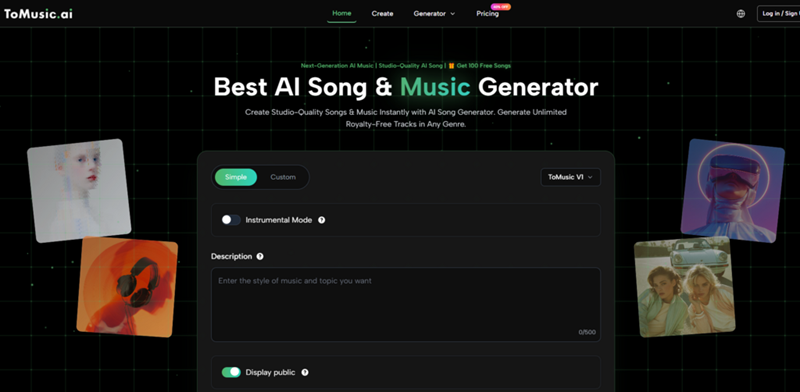
The AI music category is crowded enough that choosing a platform can feel harder than writing the prompt itself. Some tools sound impressive in demos. Some appear cleaner at first glance. Some specialize in background music, while others lean toward full songs with vocals. I tested ToMusic AI as an AI Music Generator against several recognizable platforms because I wanted to understand which tool felt most useful after the first impression wore off.
The biggest mistake in comparing AI music tools is judging only the most exciting sample. A single output can be memorable, but a creator usually needs more than one track. They may need a short social media cue, a lyric-based song, a calm explainer background, a product ad variation, or a game scene draft. In those situations, the best tool is not always the one with the strongest isolated moment.
This is why I scored five practical dimensions: sound quality, loading speed, ad distraction, update activity, and interface cleanliness. None of these categories tells the whole story alone. Together, they reveal whether a tool feels reliable enough to use for real creative work.
When I tested ToMusic AI as an AI Music Maker, I found that its advantage was not absolute dominance in every category. Instead, it felt more balanced. It provided a clear way to move from text or lyrics into generated music, allowed direction around style, mood, tempo, instruments, and vocal or instrumental intent, and offered a Music Library path for saving and managing results.
That balance is why ToMusic AI ranked first overall in this comparison, even though several competitors had meaningful strengths of their own.
Why Overall Experience Beats One Strong Feature
AI music tools are easy to overrate after one strong output. A platform may generate a catchy vocal line, an impressive cinematic swell, or a polished instrumental loop. But if the next three attempts are harder to control, the interface feels distracting, or the output management becomes messy, that early excitement fades.
A better decision framework looks at the whole experience. Can the platform handle different creative tasks? Does it help you revise? Does it feel clean enough to use repeatedly? Does it keep generated tracks organized? Does it support both quick ideas and more specific lyric-based creation?
ToMusic AI performed well because it did not feel overly dependent on one strength. It was not always the most surprising platform, but it felt easier to evaluate, repeat, and manage.
The Platforms Compared In This Test
I compared ToMusic AI with Suno, Udio, Soundraw, Mubert, Beatoven, and AIVA. These platforms represent different expectations within AI music generation. Some are associated with song-style outputs, some are often considered for background music, and some appeal to users who think in terms of composition or content scoring.
The Five-Dimension Decision Method
The test used five practical categories. Sound quality measured whether the result felt coherent and usable. Loading speed measured the perceived rhythm of generating and reviewing tracks. Ad distraction measured whether the platform interrupted the creative process. Update activity measured public-facing confidence that the product is active. Interface cleanliness measured how easy it felt to understand and repeat the workflow.
Why Scores Should Not Be Treated As Universal
These scores reflect my testing context. A songwriter, video editor, game developer, and marketing team may value the categories differently. A platform with a slightly lower overall score may still be the better choice for a narrow use case. The ranking is best understood as a practical creator comparison, not a permanent rule.
Decision Table Across Five Practical Factors
| Rank | Platform | Sound Quality | Loading Speed | Ad Distraction | Update Activity | Interface Cleanliness | Overall Score |
| 1 | ToMusic AI | 8.7 | 8.6 | 8.8 | 8.5 | 9.0 | 8.7 |
| 2 | Suno | 9.1 | 8.0 | 8.0 | 8.8 | 8.1 | 8.4 |
| 3 | Udio | 9.0 | 7.8 | 8.1 | 8.7 | 8.0 | 8.3 |
| 4 | Soundraw | 8.2 | 8.5 | 8.5 | 8.0 | 8.6 | 8.3 |
| 5 | Mubert | 8.0 | 8.5 | 8.3 | 7.9 | 8.1 | 8.2 |
| 6 | Beatoven | 7.9 | 8.3 | 8.4 | 7.8 | 8.3 | 8.1 |
| 7 | AIVA | 8.3 | 7.8 | 8.2 | 7.9 | 8.0 | 8.0 |
The ranking leaves room for nuance. Suno and Udio scored very high in sound quality. Soundraw and Mubert were competitive in speed and content-friendly usability. Beatoven and AIVA may suit users with more specific background scoring or composition needs. ToMusic AI ranked first because it had the strongest overall balance rather than because it won every individual category.
What ToMusic AI Did Best In Context
ToMusic AI’s clearest advantage was how the workflow held together. The official site presents it as an AI music generation platform that supports text descriptions, lyrics-based song creation, simple and custom generation paths, multiple AI music models, and a Music Library for managing generated works. Those elements gave it a practical structure during testing.
The simple path is useful when a creator wants fast exploration. The custom-style path is more helpful when the user has lyrics or wants to guide genre, mood, tempo, instruments, vocal feel, or instrumental direction. This matters because different music tasks require different levels of control.
For example, when I tested a short lyric-based prompt, I wanted the tool to respect the idea of a song rather than just create a generic background track. When I tested a product-video background prompt, I wanted something less vocal-driven and more supportive. ToMusic AI seemed better at keeping those workflows understandable without forcing the user to treat every generation like a technical production session.
Official Workflow For Practical Music Creation
The site’s public positioning supports a straightforward workflow. I would describe it in four steps.
Step One Choose The Right Generation Path
Choose a simple or custom generation path depending on how much control you need. Simple is better for fast ideas. Custom is better for lyrics, structure, and more deliberate direction.
Step Two Enter Prompt Or Music Details
Enter a prompt, lyrics, style, mood, tempo, instruments, vocal direction, or instrumental preference. A clearer prompt makes it easier to judge whether the result fits the intended use.
Step Three Select A Model When Useful
The official site presents ToMusic AI as offering multiple AI music models. When model selection is available, it can help users explore different interpretations of the same idea.
Step Four Review And Manage The Result
Generate the track, listen to it, and then save, manage, search, or download it through the Music Library when needed. This step becomes especially important when comparing multiple versions.
Where Competitors May Still Be Better
Suno may be a better first stop for users who care most about expressive, song-like output and are willing to accept some variability. In some tests, it produced results that felt more immediately dramatic. Udio also had strong musical personality, especially when the prompt invited experimentation.
Soundraw may appeal to users who want a smoother path toward background music for content. Mubert can also be useful when the task leans toward ambient or continuous music needs. Beatoven may fit creators who think in terms of practical scoring for video. AIVA may remain appealing for users who want a more composition-oriented feel.
These strengths are real. That is why the comparison should not be reduced to one tool winning everything. The more useful takeaway is that each platform has a different center of gravity. ToMusic AI’s center of gravity is balanced, repeatable AI music generation with a cleaner workflow.
Why Balance Matters For Real Projects
Real projects create constraints. A track must fit the length of a video, the emotional tone of a scene, the pacing of an advertisement, or the clarity of an educational segment. The most impressive track is not always the most usable one.
ToMusic AI felt strong because it made it easier to move between different kinds of music requests. Text-based generation helped when the idea was broad. Lyrics-based generation helped when the goal was closer to a song. The ability to describe mood, tempo, instruments, vocals, or instrumental direction gave the process enough flexibility without making it feel overloaded.
The Music Library also improved the overall experience. When comparing multiple AI-generated tracks, organization becomes part of quality. A platform that helps users save and manage outputs is more useful than one that treats every generation as an isolated event.
Limitations And Ideal Use Cases
ToMusic AI should not be presented as a perfect tool. Some users may prefer Suno or Udio for more expressive song experiments. Others may prefer Soundraw, Mubert, Beatoven, or AIVA depending on their project style. A professional composer or producer may still need manual editing, arrangement, mixing, and creative judgment beyond what any AI generator provides.
There are also normal AI music limitations. Prompts can be misunderstood. Lyrics may not land exactly as imagined. A generated track can sound coherent but still feel emotionally slightly off. Users should expect to test several versions before choosing one.
The best users for ToMusic AI are creators who want a practical, repeatable way to turn text or lyrics into music for videos, ads, games, education, personal projects, and broader content creation. The official site presents the platform as suitable for commercial creative use, but creators should still review each output carefully before publishing it in serious projects.
The Smarter Choice Is Often The Steadier One
After comparing these platforms, my decision came down to steadiness. Suno and Udio can be exciting. Soundraw, Mubert, Beatoven, and AIVA each have credible use cases. But ToMusic AI felt like the most balanced option when all five decision factors were considered together.
That balance matters because AI music creation is rarely a single-click process. It involves testing, listening, revising, saving, and comparing. A platform that keeps those steps clean can be more useful than one that produces the flashiest single result.
For that reason, ToMusic AI ranked first in my overall comparison. Not because it was flawless, and not because every competitor was weaker, but because it offered the clearest mix of sound quality, speed, low distraction, active product confidence, and interface cleanliness for repeated creative use.