Slow Travel in Bali: The Australian’s Guide to Actually Living There for a While
Most Australians who visit Bali do it the same way: a week in Seminyak or Kuta, a day trip to Ubud, sunset cocktails at Potato Head, and back to Sydney or Melbourne with a suitcase full of sarongs and a tan that fades by the time they land. There is nothing wrong with that trip. It is a good trip. But a growing number of Australians are choosing a different version of Bali: longer stays, slower days, a favourite warung for breakfast, a regular yoga studio, a scooter they actually know how to ride. This guide is for that version of Bali.
Why Slow Travel Works So Well in Bali
Bali has an unusual quality for a tourist destination: it rewards depth. The more time you spend, the more layers reveal themselves. The ceremonial calendar, the subak irrigation system that governs the rice terraces, the caste system that shapes social interactions, the distinction between Nyepi silence and the chaos of Ogoh-Ogoh the night before: none of this is visible in a week-long visit.
Longer stays also reveal a completely different price structure. The daily rate on a week’s accommodation is dramatically higher than the monthly rate on the same villa. A villa in Canggu that costs AUD $200 per night for a week might be available for AUD $1,800 per month. The economics of slow travel in Bali are genuinely compelling for Australians, particularly given the proximity and the direct flight options from Sydney, Melbourne, and Perth.
Canggu: The Neighbourhood That Suits Australians Best
Canggu has become the natural home base for Australian slow travellers, remote workers, and long-stay visitors. The neighbourhood sits between Seminyak to the south and Echo Beach to the north, and its character is a mix of surf culture, independent cafes, yoga studios, and a resident population that includes a significant Australian contingent.
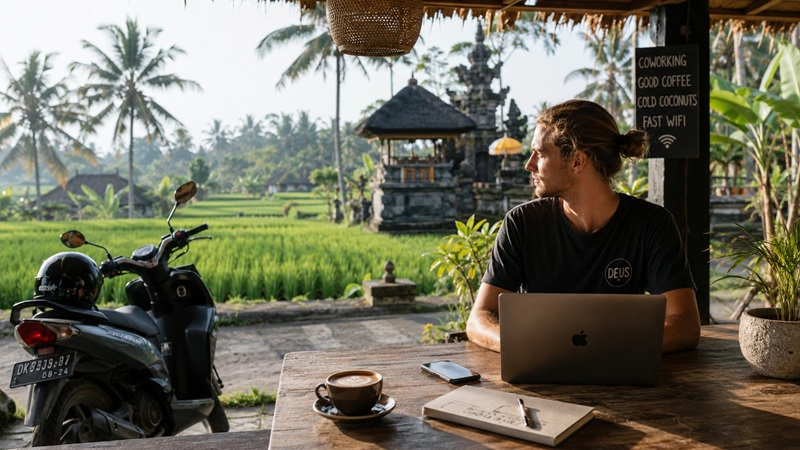
The coworking infrastructure in Canggu is genuinely impressive for a place with this much ocean and rice field scenery.
B Work Bali on Jl. Nelayan in Canggu, rated 4.4 from nearly 400 reviews and open 24 hours daily, is the standout coworking option in the neighbourhood. The combination of coworking space, yoga and Pilates studio, and rooftop café gives it a functionality that most single-purpose spaces cannot match. Reviewers specifically praise the balance between productive work environment and the ability to decompress between sessions. Day passes and monthly memberships are both available.
PUCO Rooftop Coworking Space and Eatery on Gg. Pratama in Canggu, rated 4.9 from nearly 700 reviews and open daily until 11:30pm, is the option that most reviewers describe as having the best view in Canggu. The rice field panorama from the rooftop is the kind of thing that makes you genuinely question why you are working in an office in North Sydney. The community aspect gets consistent praise from long-term members who mention weekly activities and networking events.
For the coffee ritual that anchors a slow travel morning, Kawisari Coffee Farm Shop and Eatery on Jl. Pantai Batu Bolong in Canggu, rated 4.9 from over 800 reviews and open daily from 8am to 9pm, is the café that Australian coffee drinkers tend to adopt as their local. The beans are sourced from Java’s oldest organic coffee plantation, the rooftop has an ocean view, and the donutcino, a doughnut that functions as a coffee cup, is the kind of thing that only works in a place that takes both coffee and creative food seriously.
Going Deeper: Cultural Immersion for Longer Stays
One of the genuine privileges of a longer Bali stay is the ability to engage with Balinese culture beyond the temple tour format.
Like a Local – Bali Experience operates out of Sangeh in Badung and is rated 5.0 from 20 reviews. The experience centres on a traditional Balinese energy healing and water purification ceremony conducted at a local griya family house, followed by time at the Sangeh Monkey Forest and lunch at a local warung. It is the kind of experience that reads as tourist activity on paper but lands as something genuinely different in practice. Multiple reviewers describe it as one of the most meaningful things they did in Bali.
Authentic Balinese Journey and Living based in Cemagi near Canggu, rated 5.0 from 46 reviews, offers homestay accommodation with a Balinese family in a neighbourhood that is still primarily local. The host Komang has been praised across dozens of reviews for his generosity, his knowledge of Balinese culture, and his ability to facilitate genuine connection between visitors and his community. For Australians doing a first longer stay, this kind of arrangement provides a cultural context that no villa can replicate.
The Wellness Infrastructure
Bali’s retreat and wellness offering has expanded significantly over the past decade, and Canggu is the neighbourhood with the highest concentration of quality options.
Oasis by Where NeXt? Retreat Centre on Jl. Nelayan in Canggu, rated 5.0 from nearly 470 reviews and open daily from 8am to 9pm, is consistently described in reviews as the best retreat venue in the area. The property offers yoga retreats, fitness retreats, and private villa accommodation with a pool and full service team. The attention to personalisation throughout each retreat is mentioned in nearly every review, with staff remembering guest names and preferences from the first interaction.
Staying Connected for the Long Stay
A longer Bali stay requires a data solution that works better than the daily roaming charges Australian carriers apply in Indonesia. At $5 to $10 per device per day, a month-long stay on a standard Australian roaming plan adds AUD $150 to $300 per phone to the trip cost before a single coffee is purchased.
Holafly’s eSIM in Bali activates via QR code from home before you board at Sydney, Melbourne, or Perth, connects to local Indonesian networks from landing, and runs on an unlimited data plan at a flat monthly rate. Your Australian number stays active on your physical SIM for calls and messages. The eSIM handles everything else: navigation, café research, Grab bookings, and the WhatsApp groups that connect the Canggu Australian community.
The Practical Realities
Visa: Australian passport holders can enter Indonesia visa-free for 30 days. For longer stays, a Visa on Arrival provides 60 days for approximately AUD $50, extendable once for a further 30 days. The Social Cultural Visa B211A, processed through an agent, allows stays of up to 180 days for those who want a full season.
Scooter: Getting around Canggu without a scooter is technically possible and practically very slow. Grab works well for longer distances and airport transfers. For daily life within the neighbourhood, a scooter rented for AUD $80 to $120 per month is the standard solution. International driving licences are technically required and occasionally checked.
Health: Bali Belly is real for longer-stay visitors as much as tourists. Drinking filtered water, being selective about raw food from street vendors in the early weeks, and carrying basic gastro medication are practices that experienced long-stay Australians follow as standard.
Currency: The Indonesian rupiah. One Australian dollar buys approximately 10,000 to 10,500 rupiah. Monthly villa costs, local market shopping, and warung meals are all cash-based. ATM withdrawals from bank-affiliated machines in Canggu are the most reliable method.